
Original Article by Grant Gravitt
“It was like a simulated airplane wreck. There were that many people.”
The party was called “Only the Strong Survive.”
By sundown, the name was no longer merely clever.
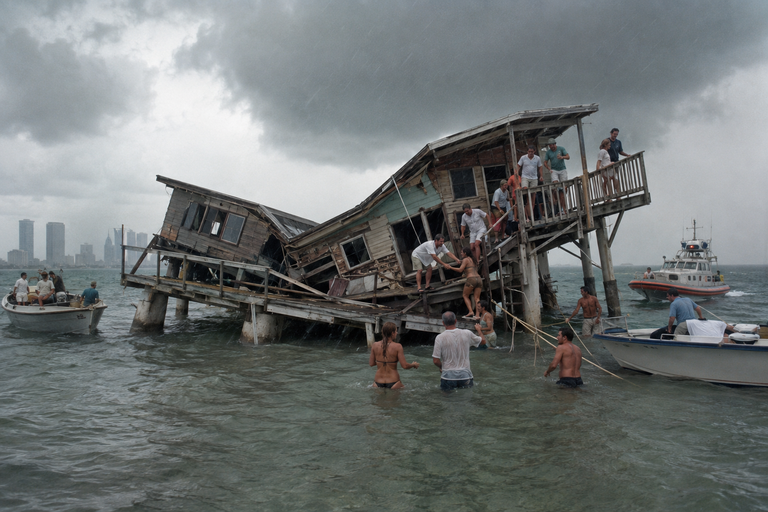
One of the craziest things I ever experienced was a party where the house actually collapsed beneath us—or nearly did. The building did not disappear completely into Biscayne Bay. Instead, it buckled, cracked and folded into a giant V while hundreds of people scrambled into the shallow water below.
Fortunately, all the partygoers survived. The house did not fare quite as well.
A photograph taken before the storm shows me enjoying what was supposed to be another memorable day on the bay. None of us knew that within hours we would be appearing on live television throughout South Florida—and eventually around the country.
I later learned that an interview with me, recorded while I was sitting in the back of an ambulance, had made it onto CNN. A family friend in Australia even called to make sure we were alive.
For one strange afternoon, a party in the middle of Biscayne Bay became national news.
Stiltsville Before the Collapse
Stiltsville is one of those places that could only have existed in Miami.
The community consisted of rustic wooden houses standing on pilings above the shallow waters south of Key Biscayne. The buildings were accessible only by boat and seemed to float between the Miami skyline and the open Atlantic.
The first structures appeared during the 1930s. By 1960, Stiltsville had grown to 27 buildings. Over the decades, the settlement became associated with fishing retreats, private clubs, prominent Miami families and stories involving illegal liquor, gambling and the notorious Bikini Club.
It was part fishing village, part weekend retreat and part Miami legend.
As a member of the now-long-gone Bachelor/Spinster Clubs of Miami, I attended a midsummer Stiltsville party that had become one of the highlights of our social calendar. It was somewhere around the 50th edition of the event, as I remember it.
The day began in midmorning, with Monty’s in Coconut Grove serving as the gathering point. From there, boats carried everyone across the bay to the house.
The party was billed as “Only the Strong Survive.”
Miami would soon test the slogan.
When the Weather Changed
A major summer storm had been pounding the mainland. Eventually, it moved across Biscayne Bay and found us.
When the hard rain and wind arrived, the crowd scattered in three directions.
Some people headed toward the boats tied to the dock. That was probably the safest choice.
Others sought shelter along the walkway underneath the house. That may have been the worst place to go.
The rest of us moved inside, where the Miami rhythm-and-blues band Little Nicky and the Slicks was playing for a packed dance floor.
Then the generator stopped. The music died. Seconds later, the house began to break.
There was a tremendous cracking sound as the center of the structure dropped. The floor split, the walls shifted and the building folded sharply in the middle.
The party was suddenly over.
Falling Through the Floor
Dozens of people slid, fell or jumped into the waist-deep water below.
I had been heading toward the dance floor with a friend and was fortunate enough to be holding her hand. When the floor fractured, she slipped through one of the openings.
Exposed pipes were only inches away. Had she fallen differently, she could have been impaled. I pulled her back up.
That was when my bad knee gave way. Snap.
I had damaged my anterior cruciate ligament for the fifth time—on the way to what would eventually become seven ACL injuries.
The newspapers classified the injuries from the collapse as minor. That word depends considerably on whether you are the person writing the report or the person being loaded into the ambulance.
At least eight people were reported injured. Six were treated at Mercy Hospital and released. I also remember a member of the Elias family suffering a painful back injury. Numerous others left with cuts, bruises and stories they would repeat for the rest of their lives.
But no one was killed. Considering how many people had been packed into that small house, that was remarkable.
Getting Everyone Into the Water
Because I was probably one of the only sober people at the party, I stayed behind and helped get people out.
At that moment, we did not know whether the damaged house would remain standing. Our priority was to move everyone away from it as quickly as possible.
We helped people climb over the balcony and into the water. Some jumped from the railing. Others were lowered over the edge and dropped into the bay.
People aboard nearby boats threw ropes into the water and pulled partygoers aboard. Those already in the bay helped steady the people coming down behind them.
What I remember most clearly was how calm nearly everyone remained.
There was fear and confusion, but there was no uncontrolled stampede. People helped strangers. Stronger swimmers assisted weaker ones. Boat owners took aboard anyone they could reach.
At the same time, local television stations began broadcasting live reports. Some early reports incorrectly suggested that several people had died.
Thankfully, they were wrong.
A Code Red on Biscayne Bay
The incident was declared a Code Red emergency.
Helicopters from the Coast Guard and Metro-Dade Fire Rescue hovered above the house. Rescue divers entered the water and searched beneath the damaged structure for anyone who might be trapped.
They found no one. The shallow water probably helped save lives. More importantly, the house did not fall completely into the bay. Its center sagged while portions of the structure remained supported by the pilings.
Ray Rodriguez of the Metro-Dade Marine Patrol, one of the first officers to reach the scene, described the house as bending in the middle “like a V.”
He compared the number of people pouring from the structure to a mass-casualty training exercise:
“It was like a simulated airplane wreck. There were that many people.”
Some estimates placed more than 200 people inside the house when it buckled. Other accounts placed the number closer to 150. Either figure was far too many for a house reportedly measuring only about 800 to 900 square feet.
Officials concluded that the building had been overloaded.
A partygoer identified in the press as Joe Kuntz—a name that always struck me as suspiciously convenient—had been standing underneath the structure when it buckled. He recalled the noise but also remembered how calmly people reacted.
The water was only two or three feet deep in places. The greatest danger was not drowning. It was being caught beneath the collapsing house.
The Strangest Ambulance Ride in Miami
About 30 private boats joined vessels from the Florida Marine Patrol, Coast Guard and Metro-Dade Marine Patrol in carrying people away from the scene.
Many guests who were not injured simply climbed back aboard their boats and motored away.
The rest of us were initially taken toward Crandon Marina on Key Biscayne. When we reached the docks, an argument erupted among responding agencies over jurisdiction. We were told that Coral Gables had authority over the waters where the collapse occurred.
Eventually, I was transported to Mercy Hospital. I climbed into an ambulance, traveled what seemed like a quarter of a mile to the emergency room and later received an $800 bill for the privilege.
Even in an emergency, Miami knows how to provide a memorable ride.
The Party After the Party
Of course, the after-party continued. Many of us eventually gathered back at Monty’s to compare injuries, trade stories and meet the reporters who were waiting to interview survivors.
Television crews recorded people talking, laughing and trying to understand what had just happened.
I remember advising everyone to at least try to look sad. After all, we had just survived a major structural collapse. It would not look particularly dignified if the evening news showed us smiling through all the B-roll.But relief has a funny appearance. Sometimes, after you realize everyone is alive, it looks remarkably like a party.
Seventy-Two Days Before Hurricane Andrew
The Stiltsville collapse occurred on Saturday, June 13, 1992.
Just 72 days later, Hurricane Andrew struck South Florida.
At the beginning of 1992, approximately 14 Stiltsville structures remained. Andrew destroyed six of them, leaving seven standing above the bay. A fire destroyed another in January 2021.
Today, six Stiltsville houses remain. They are maintained through an agreement between Biscayne National Park and the nonprofit Stiltsville Trust. The houses are closed to ordinary public access, although visits may be arranged through permits and authorization from the Trust.
They survive as weathered reminders of an older Miami—a city of fishermen, gamblers, judges, boaters, musicians, adventurers and people willing to build houses in the middle of the bay simply because someone told them it could be done.
I have included photographs and press coverage from that unforgettable day, along with a picture of what may be the most accurate event T-shirt ever produced.
And thus ends my story of how we survived the famous Stiltsville house collapse of 1992.
It was before Hurricane Andrew. Stiltsville house collapse: Hurricane Andrew struck South Florida: The party-house collapse happened 72 days before Andrew. Andrew later destroyed six additional Stiltsville structures, leaving only seven standing.
Only the strong survived.
Apparently, the houses didn’t.
Editor’s Note: As a child—probably ten or twelve years old—I went to Stiltsville all the time from either Key Biscayne or Coconut Grove. Sometimes we traveled by kayak or canoe. Other times, we arrived aboard improbable homemade contraptions assembled from old doors, inner tubes and whatever else we could find, occasionally fitted with makeshift sails.
Much of that would never be allowed today, even if children could still reach the houses on their own. But that freedom was part of Miami’s culture. Later, we returned to catch spiny lobsters around the houses.
Six Stiltsville structures still stand, but people no longer experience the place as freely as we once did. That is a real shame. Stiltsville is one of those uniquely Miami things that did not disappear all at once. The old way of life gradually faded—partly because of government restrictions, partly because of growing crowds and partly because hurricanes kept carrying pieces of it away.
————


Historical note
Contemporary Miami Herald photographs and reporting date the collapse to June 13, 1992, and reported at least eight injuries. Estimates of the crowd varied from
approximately 150 to more than 200 people. The National Park Service reports that Stiltsville reached 27 structures at its peak and that Hurricane Andrew left seven standing later in 1992.
Sources: Flashback Miami’s Miami Herald archive, Biscayne National Park’s Stiltsville history, current National Park Service access information, and Miami Herald’s history of Stiltsville.
