
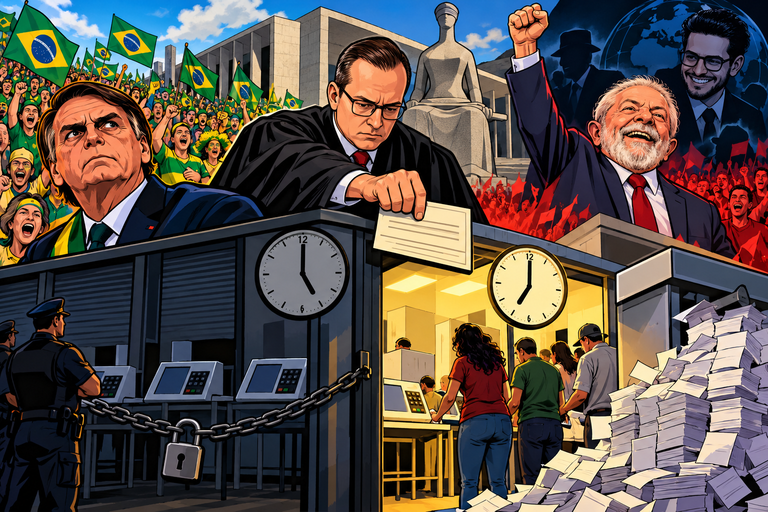
The Most Obvious Voter Fraud Ever? — A story of a failed Socialist Democracy, Political Corruption, and the Remarkable Ability of Politicians to Discover Votes When They Need Them
There is an old saying that it doesn’t matter who votes. What matters is who counts the votes.
I would add something to that. Apparently, it also matters who gets to change the rules, who gets to keep the polling stations open, who gets to close them, and whether the judge making those decisions happens to be your former criminal defense attorney.
Welcome to Brazil. A country with more than 200 million people, enormous natural resources, tremendous economic potential, and a political system that occasionally makes a three-ring circus look like a professionally managed accounting firm.
And now we have another election controversy.
One that raises some extraordinary questions about voting procedures, judicial independence, political influence, and the very meaning of democracy.
According to the account circulating about this election, conservative candidate Flávio Bolsonaro appeared positioned for a major victory. The rallies were enormous. The political momentum seemed to favor the right. And the first-round results appeared to suggest that a conservative victory was within reach.
Then something rather remarkable allegedly happened. Lula won.
Not simply by picking up a few unexpected votes, but through a reported shift of approximately ten million votes between rounds.
And, according to the allegations, controversial last-minute judicial intervention regarding polling hours complicated an already contentious election.
Now, I have been around long enough to know that elections occasionally produce surprises. But surprises are one thing.
Changing the rules while the game is being played is quite another.
And when the people changing those rules have personal and political relationships with those competing in the election, the public has every reason to start asking questions.
Serious questions. Not because the losing candidate is automatically right, but because democracy requires something considerably more substantial than the winning candidate declaring that everything was perfectly legitimate.
1. THE ELECTION THAT WAS SUPPOSED TO GO THE OTHER WAY
Before discussing the allegations surrounding the final voting hours, it is important to understand why the result has generated so much controversy among Bolsonaro supporters.
The original account presents Flávio Bolsonaro, aligned with Donald Trump’s nationalist-populist political movement, as the candidate enjoying the momentum.
According to that account, Bolsonaro finished the first round approximately four million votes ahead of Lula.
His rallies attracted enormous crowds.
Thousands upon thousands of enthusiastic supporters filled the streets, waved Brazilian flags, and demonstrated the kind of political energy associated with Donald Trump’s largest American rallies.
The argument is that this was not simply a candidate enjoying respectable support.
This was a political movement.
And movements, unlike traditional political campaigns, can develop momentum that extends beyond the personalities leading them.
Brazil’s political right had become energized.
The population was restless.
Voters were reportedly looking for change.
And Bolsonaro was presented as the beneficiary of that dissatisfaction.
Meanwhile, Lula represented the opposite political direction.
A longtime left-wing political figure, previously convicted in corruption proceedings that later became the subject of major judicial controversy, Lula had become a symbol of the political establishment that Bolsonaro’s supporters wanted to defeat.
To those voters, Lula represented everything they opposed: socialism, political patronage, institutional power, and a government that they believed had become increasingly disconnected from ordinary Brazilians.
Now consider the arithmetic.
This is where the accusations become particularly interesting.
2. THE MYSTERY OF THE TEN MILLION VOTES
Brazil’s presidential election uses a two-round system.
If no candidate wins outright during the first round, the two leading candidates proceed to a runoff.
Simple enough.
But the original argument points to something unusual about the distribution of votes between the two rounds.
According to the figures presented:
- First-round voter turnout was approximately 125 million.
- Second-round turnout increased to approximately 128 million.
- Approximately 9.5 million first-round votes had gone to candidates other than Lula and Bolsonaro.
- Bolsonaro reportedly increased his total from approximately 56 million to 60 million votes.
- Lula reportedly gained approximately ten million additional votes.
- When changes in abstentions, blank ballots, and invalid ballots were considered, the account identified a pool of approximately 14 million potentially redistributed votes.
Of that estimated pool, the argument suggests Bolsonaro received approximately 29 percent, while Lula received approximately 71 percent.
Now, here is the question.
If the other candidates represented predominantly right-wing political positions, why would such a substantial proportion of their voters suddenly support Lula?
What happened in three weeks?
Did millions of conservative voters suddenly wake up one morning, abandon their political convictions, and decide that Lula was their man?
Perhaps.
People do strange things.
I once knew someone who bought a French automobile twice.
But unusual political behavior deserves examination, particularly when it occurs during a highly polarized election.
The central argument is that Bolsonaro should have benefited disproportionately from the elimination of other right-leaning candidates.
Instead, according to the figures presented, Lula benefited.
Does that automatically establish fraud?
No.
Voters are not cattle. They do not automatically transfer their votes according to ideological labels.
Some abstain. Some switch candidates. Some vote against a personality rather than for a political program.
But the magnitude of the claimed change is precisely why the numbers deserve transparent examination.
Where did the votes come from?
Which districts produced them?
How did turnout change?
And how closely do the final results match the voting patterns observed during the first round?
Those are questions that can be answered with election data.
And they should be.
Because mathematics may not prove an election was stolen, but mathematics can help determine whether the explanations offered for an unexpected result are credible.
3. WHEN FIVE O’CLOCK SUDDENLY DOESN’T MEAN FIVE O’CLOCK
Now we arrive at what may be the most serious allegation in the account.
The voting schedule.
According to the description, Brazilian polling stations were scheduled to operate from 8:00 a.m. until 5:00 p.m.
Everybody knew the rules.
Candidates knew them.
Political parties knew them.
Election administrators knew them.
And voters knew them.
Then, according to the allegations, something extraordinary happened shortly before the polls closed.
A Supreme Court justice reportedly intervened to extend voting by two additional hours.
Not the electoral tribunal ordinarily responsible for administering the election.
A Supreme Court justice. And not just any justice.
The account identifies Cristiano Zanin, who previously represented Lula as a lawyer.
Now consider the implications. You are operating an election. Millions of people are voting.
Thousands of polling stations are processing ballots. The rules are already established.
And suddenly, near the conclusion of voting, someone changes the closing time.
What happens to polling stations that have already shut down?
What happens to machines that have completed their voting procedures?
What happens to voters who were told the polls were closed?
And what happens if one political constituency benefits disproportionately from the extension?
These are not minor administrative questions. They go directly to the fairness of the election. The allegations go further.
They suggest that some polling stations in Bolsonaro-supporting districts had already closed and could not reopen their voting machines, while stations in Lula-supporting areas were able to continue operating.
If that happened as described, it would create an obvious problem. An election cannot operate under two different sets of rules.
You cannot tell one group of voters that the game is over while telling another group that they have two additional hours to participate.
Imagine a football game. The clock reaches zero. One team is ahead. The referee announces that the game has ended.
But then someone from the league office calls and says the losing team may continue playing for another fifteen minutes.
The winning team, meanwhile, has already left the field.
Would you consider the final score legitimate? Of course not. But apparently we are supposed to accept considerably more questionable procedures when the prize is control of an entire country.
4. THE JUDGE WHO USED TO BE THE PRESIDENT’S LAWYER
Here is another aspect of the controversy that deserves attention.
The account identifies Supreme Court Justice Cristiano Zanin as Lula’s former lawyer, including his representation in corruption-related legal proceedings.
That relationship is important. Not because a lawyer can never become a judge. And not because every decision involving a former client is automatically corrupt.
But because impartiality is not merely a legal technicality. It is the foundation of public confidence in the judiciary. Judges must be impartial. And they must appear impartial.
When a judge becomes involved in a decision capable of affecting the electoral fortunes of a former client, particularly under highly unusual circumstances, questions about recusal become unavoidable.
Why was this particular justice involved? Why was the matter reportedly taken to the Supreme Court rather than handled through the electoral tribunal?
Who requested the intervention? What legal authority supported the extension?
And why was the decision reportedly made so close to the established closing time?
These questions do not require anyone to be a supporter of Bolsonaro.
They do not require opposition to Lula. They require only a belief that the rules governing elections should be administered impartially.
One of the allegations is that the intervention bypassed Brazil’s established electoral administration.
If accurate, that would be particularly troubling. The whole purpose of having an electoral court is to place election administration within a recognizable legal structure.
Otherwise, why have an electoral court at all? Why not simply let the president telephone whichever judge he likes?
Or perhaps establish a government department called the Ministry of Convenient Election Results.
It would certainly simplify the bureaucracy. Although I suspect it might complicate democracy.
5. THE ELECTORAL AUTHORITIES AND THE CLAIM OF AN UNPRECEDENTED DECISION
The original account attributes considerable concern to Brazilian election lawyers and electoral authorities.
It describes reports suggesting that extending polling hours after some stations had already closed was unprecedented.
According to the account, several election lawyers warned that such a decision could create serious legal complications.
One concern involved the inability of voting machines to resume operations after their procedures had been completed.
Another involved the possibility that the extension would affect some districts differently from others.
A third involved the legal authority for changing voting hours after the process had already begun.
The account also attributes objections to the leadership of Brazil’s electoral court, including concerns about the lack of established regulations for a last-minute extension.
These allegations are particularly important because they concern election procedure rather than merely political preference.
The basic issue is straightforward. If the rules say polling ends at five, and an authority changes those rules at the last moment, administrators must be able to explain precisely how that decision was implemented.
Which polling stations remained open?
Which had already closed?
Which were able to reopen?
How many additional ballots were cast?
Which districts received additional voting time?
And what was the political distribution of those districts?
Those records should not be mysteries. They should be public information.
According to the original account, approximately 80 percent of polling stations had already closed when the extension was announced.
That is a particularly serious claim. If true, it would make the exact distribution of the remaining open polling stations critically important.
A two-hour extension sounds harmless until you discover that it might not actually provide two additional hours to everybody.
The principle should be simple.
Every eligible voter deserves the same opportunity to vote under the same legally established rules.
Not two sets of rules. Not two closing times depending on political geography.
And certainly not a system in which one candidate’s supporters believe the rules were changed to benefit the other.
6. WHAT HAPPENED WHEN THE LIGHTS CAME BACK ON?
Another allegation concerns the vote totals reported after the disputed period.
The original account claims that Lula’s vote total increased dramatically, with approximately ten million additional votes compared with the first round.
Its central suggestion is that an unusual jump in the reported results followed the disputed judicial intervention.
This is the part of the story that requires particularly careful distinction.
An increase between election rounds is not the same thing as discovering ten million ballots during a two-hour extension.
The two claims involve different calculations. Nevertheless, the broader question remains important.
If there was a late change to the voting process, what measurable effect did it have on the election results?
How many ballots were actually cast during the extension? Where were they cast?
What was the margin in those locations? And could the disputed procedure have changed the outcome?
That is the proper way to examine the allegation. Not by accepting the government’s assurances.
Not by accepting the opposition’s accusations. But by examining the records.
An election ought to be auditable. If the machines are reliable, prove it.
If the procedures were lawful, demonstrate the legal authority.
If the voting hours were extended equally, publish the evidence.
If the result was unaffected, produce the calculations.
It should not require a political revolution to obtain answers to elementary questions about a national election.
7. IMAGINE THIS HAPPENING IN THE UNITED STATES
Consider an American equivalent.
Imagine a presidential election in which Pennsylvania, Michigan, Wisconsin, and Georgia are among the decisive states.
The polls close.
Election administrators begin reporting results.
Then, at the last possible moment, a Supreme Court justice issues an order allowing additional voting in selected locations.
Suppose Philadelphia, Detroit, Milwaukee, and Atlanta are affected, while voting has already ended in numerous Republican-leaning districts.
Now imagine that the justice issuing the order previously served as the personal criminal defense attorney for one of the presidential candidates.
Would Republicans accept that without question?
Of course not.
Would Democrats accept it if the political circumstances were reversed?
I rather doubt it.
And they should not have to.
Because the question is not whether the decision benefits Republicans or Democrats.
The question is whether an election is administered according to established rules that apply equally to everybody.
That is the distinction politicians seem to forget whenever their preferred candidate wins.
A questionable procedure does not become acceptable because it produces the result you wanted.
And a legitimate procedure does not become fraudulent merely because your candidate loses.
The rules have to matter more than the political outcome.
Otherwise, elections eventually become nothing more than an elaborate ceremony for announcing decisions that have already been made.
8. THE INTERNATIONAL OBSERVER QUESTION
The original account also alleges that Brazil restricted or excluded independent international election observers before the vote.
If true, that raises another concern.
Why would a government confident in the integrity of its elections object to independent scrutiny?
International observers are not supposed to determine who wins.
They are supposed to help establish whether the process is transparent, lawful, and fairly administered.
Their presence can protect the winner just as much as the loser.
A legitimate victory becomes stronger when independent observers can confirm that established procedures were followed.
Conversely, restrictions on observation can create suspicion, particularly when combined with allegations of unusual judicial intervention.
The answer is not necessarily that fraud occurred.
The answer is that transparency becomes more important when trust is already weak.
A confident government should welcome legitimate scrutiny.
Publish the records.
Explain the procedures.
Show the numbers.
Demonstrate that the outcome reflects the voters.
That is how democratic institutions earn public confidence.
Not by demanding that everyone stop asking questions.
9. SOROS, THE INTERNATIONAL LEFT, AND THE CELEBRATION
There is also an international political dimension to this controversy.
The original account points to public celebrations by Alex Soros and left-wing political figures, including Zohran Mamdani.
It portrays Lula’s apparent victory as an important success for an international network of progressive, socialist, and globalist political interests.
That is not an insignificant political observation.
Brazil is the largest country in South America.
It has enormous economic resources.
It occupies a major strategic position in the Western Hemisphere.
And its political direction matters far beyond its borders.
For international progressives, a Lula victory represents the survival of a major left-wing government in a region where conservative and nationalist movements have gained substantial political strength.
For conservative movements, Bolsonaro represents a potential ideological ally in the struggle against socialism, globalism, and the expansion of centralized political power.
It is therefore understandable that international political organizations and activists would take an intense interest in Brazil’s elections.
But celebrating an election result and participating in election manipulation are two different things.
The existence of international political connections does not itself establish wrongdoing.
If there are allegations of foreign influence, funding, or coordination, those allegations require financial records, communications, and other evidence.
That should be investigated where credible grounds exist.
Because foreign influence in national elections is a serious concern regardless of whether it comes from the political left or right.
The larger issue is whether outside interests are shaping domestic democratic outcomes through legitimate political advocacy or improper interference.
And that distinction matters.
10. BRAZIL IS MORE THAN AN ELECTION — IT IS A GEOPOLITICAL PRIZE
Why does Brazil matter so much?
Because whoever controls Brazil helps determine the political and economic direction of South America.
Brazil is not some tiny country whose internal politics have little international consequence.
It is an agricultural powerhouse.
A major energy producer.
A manufacturing economy.
A member of BRICS.
And an important trading partner for China, the United States, Europe, and much of the developing world.
Its political leadership influences regional diplomacy, international trade, economic alliances, environmental policy, and relations with authoritarian governments.
The original argument places Brazil within a broader ideological struggle across South America.
It suggests that right-wing political movements have been gaining ground while established socialist and progressive political networks have been losing influence.
From that perspective, retaining control of Brazil would be enormously valuable to the international left.
A Brazilian government aligned with socialist political movements offers strategic influence throughout the region.
It can shape diplomatic relations.
Influence regional political organizations.
Support international alliances.
And provide legitimacy to ideological movements seeking to expand their influence.
The original account also links these concerns to the reduction of USAID funding and broader changes in American foreign policy.
Its thesis is that international political organizations facing diminishing resources and political setbacks would have a powerful incentive to preserve their position in Brazil.
Incentive, however, is not proof.
Political actors may have strong reasons to prefer one result without possessing the means to manipulate it.
The proper question is whether the alleged irregularities were real and whether any improper coordination occurred.
Brazil matters too much for those questions to be dismissed casually.
11. WHAT ABOUT THE MARKETS?
The original commentary also points to negative financial-market reactions as evidence of concern about Lula’s political direction.
That deserves consideration, although markets are not election auditors.
Investors may react negatively to higher expected government spending, taxation, regulation, fiscal uncertainty, or political instability.
They may also react to concerns about monetary policy, international trade, or the direction of economic reform.
A market decline does not establish that an election was fraudulent.
But it can demonstrate that investors are concerned about the consequences of a particular political outcome.
And in Brazil, those consequences matter.
Political instability can discourage investment.
Capital can leave.
Businesses can postpone expansion.
Government borrowing costs can rise.
And ordinary citizens eventually pay the price.
Politicians may enjoy arguing over ideological victories.
Investors generally prefer knowing whether their property, contracts, currency, and business interests will remain secure.
The greater the political uncertainty, the more difficult those decisions become.
Which is another reason election legitimacy matters.
A government that enters office amid unresolved questions about the electoral process starts with a problem that cannot be solved simply by declaring victory.
12. THE BIDEN STATE DEPARTMENT, TRUMP, AND AMERICAN FOREIGN POLICY
The original account alleges that the Biden administration and elements of the American foreign-policy establishment previously favored Lula and helped his political interests.
It also calls on the Trump administration and the State Department to intervene in response to the present allegations.
That introduces another question.
What responsibility does the United States have when a major regional democracy faces accusations of election misconduct?
I would argue that the United States has a legitimate interest in democratic stability throughout the Western Hemisphere.
But that does not mean Washington should simply decide who deserves to govern Brazil.
The proper American interest is in lawful, credible, and transparent elections.
If serious evidence emerges that voting procedures were unlawfully changed or that the judicial system was improperly used to advantage one candidate, the United States should support an independent examination.
That could include diplomatic pressure for transparency and the involvement of credible international observers.
But any decision to annul an election must be grounded in Brazilian law and supported by evidence.
Otherwise, we would merely be replacing one disputed form of political interference with another.
The purpose of American foreign policy should not be to manufacture friendly election results.
It should be to support a regional environment in which democratic institutions can function independently.
That principle should apply whether the winning candidate is conservative, socialist, liberal, or something else entirely.
13. SHOULD THE ELECTION BE ANNULLED?
The original commentary calls for the immediate annulment of the election and a new vote.
It also refers to suggestions that a new election might be organized within approximately 20 to 40 days.
That is an extraordinary remedy.
And extraordinary remedies require extraordinary justification.
An election should not be overturned merely because the losing candidate believes the result is suspicious.
Nor should an election be certified without meaningful examination if credible evidence indicates that legally established voting procedures were violated in ways capable of changing the outcome.
The standard should be straightforward.
First, establish what happened.
Determine whether polling hours were altered, by whom, under what legal authority, and in which districts.
Second, determine whether any voters were improperly denied the opportunity to cast ballots.
Third, establish how many votes were affected by the disputed procedures.
Fourth, assess whether those irregularities could have changed the final result.
And finally, determine the appropriate remedy under Brazilian law.
That remedy might involve correcting administrative errors.
It might involve recounting or auditing results.
It might involve judicial review.
Or, if sufficiently serious and outcome-determinative violations were established, it could justify a new election.
But the remedy must follow the evidence.
Not the political preferences of the government.
And not the anger of the opposition.
14. THE BIGGER PROBLEM: POLITICIANS HAVE LEARNED TO USE INSTITUTIONS AS WEAPONS
This is where the argument moves beyond Brazil.
Because the fundamental problem is not unique to one country or political party.
Over time, many political systems develop an unhealthy relationship between elected officials, courts, bureaucracies, regulatory agencies, and the institutions supposedly responsible for keeping government accountable.
Politicians appoint judges.
Judges make decisions affecting politicians.
Political parties influence administrative appointments.
Government officials exercise authority over the electoral machinery.
And eventually the public begins wondering whether anyone is genuinely independent.
The institutional structure may look impressive.
There may be constitutional provisions, commissions, tribunals, procedural manuals, and officials with distinguished titles.
But what happens when personal loyalties become more important than institutional responsibilities?
What happens when judges are perceived as political operatives?
What happens when an electoral authority appears to favor one side?
And what happens when the public begins believing that the institutions designed to protect democracy have become instruments for controlling it?
At that point, the problem becomes much bigger than one election.
It becomes a crisis of legitimacy.
You can compel people to obey a government.
You cannot compel them to trust it.
And once trust in elections begins to disappear, restoring it becomes extremely difficult.
15. THE REAL DANGER IS NOT THAT THE WRONG PERSON WON
I want to make something perfectly clear.
I am not suggesting that every unexpected election result proves fraud.
Sometimes the candidate with the largest rallies loses.
Sometimes the polls are wrong.
Sometimes voters change their minds.
Sometimes the political establishment wins despite enormous popular resentment.
And sometimes the candidate you personally dislike receives more votes.
That is democracy.
But democracy also requires transparency.
The argument presented about Brazil involves several specific allegations: unusual voting-hour extensions, judicial intervention by a former lawyer for one candidate, unequal access to polling stations, questionable changes in voting totals, and concerns about independent observation.
Those are serious allegations.
They should be addressed individually.
If false, demonstrate that they are false.
If exaggerated, publish the records that establish what actually happened.
If legitimate administrative decisions were made, explain the legal authority behind them.
And if unlawful conduct occurred, hold the responsible officials accountable.
That is how a functioning democracy should respond.
What it should not do is treat questions about election procedures as illegitimate simply because they are politically inconvenient.
Nor should the opposition treat suspicion as conclusive evidence of criminal conduct.
Both approaches undermine public confidence.
And both make future elections more difficult to administer.
16. YOU CANNOT HAVE DEMOCRACY WITHOUT TRUST
Here is something I learned many years ago in business.
When money is involved, everybody wants accountability.
Nobody wants to invest in a company whose accountant can change the books after the fiscal year ends.
Nobody wants to buy property from someone who can rewrite the contract after the closing.
Nobody wants to play poker with a dealer who changes the rules after looking at everybody’s cards.
Yet somehow, when the stakes involve control over an entire national government, we are told that asking questions is unreasonable.
That makes absolutely no sense.
An election is effectively the largest accounting exercise a democracy undertakes.
Millions of individual decisions must be recorded accurately.
The rules must be established in advance.
The counting process must be consistent.
The results must be auditable.
And the people administering the system must be accountable.
If a corporation conducted its annual shareholder vote under procedures that were changed at the last minute by a director’s former personal attorney, shareholders would demand an explanation.
They might demand an independent audit.
They might file lawsuits.
They might challenge the entire process.
Why should citizens expect anything less when selecting the person who will control their government?
Democracy deserves at least the same standard of accountability as a publicly traded corporation.
Preferably considerably more.
17. BRAZIL DESERVES ANSWERS
The people of Brazil deserve to know whether their election was conducted lawfully.
Lula supporters deserve confidence that their votes were properly counted.
Bolsonaro supporters deserve confidence that their votes were not disadvantaged.
And the international community deserves an accurate understanding of the procedures used to determine the leadership of one of the world’s most important countries.
If the allegations about last-minute judicial intervention and unequal polling hours are supported by evidence, they deserve serious legal examination.
If the alleged ten-million-vote shift can be explained by ordinary runoff voting behavior, that explanation should be demonstrated using public election data.
If international election observers were restricted, the reasons should be explained.
If the judge’s prior relationship with Lula created a conflict of interest, the legal and ethical questions should be examined.
None of these questions requires a predetermined conclusion.
What they require is transparency.
A nation of more than 200 million people should not be expected to accept a disputed election merely because the people in charge say everything is fine.
And the losing side should not be allowed to overturn an election merely because the arithmetic surprises them.
The answer is the same in both cases.
Open the books.
Show the records.
Explain the decisions.
Let the evidence determine the conclusion.
THE OUTCRY — WHEN AN ELECTION BECOMES A NATIONAL CONTROVERSY
And then came the accusations. According to the accounts circulating among Bolsonaro supporters, the election was not merely suspicious—it was being denounced as a scam. Flávio Bolsonaro reportedly challenged the legitimacy of the result, declaring that what happened was unacceptable and that the election could not be recognized. Election lawyers were described as raising concerns about the unprecedented last-minute extension of voting hours, while critics questioned the authority of Supreme Court Justice Cristiano Zanin, Lula’s former attorney, to intervene in the process.
Polling stations had already closed and voting machines could not be restarted. Meanwhile, opposition supporters accused the political establishment of manipulating the rules to protect Lula, and the controversy spread into international political circles. Some called for the election to be annulled, others demanded a new vote, and still others urged the Trump administration and the State Department to intervene.
These accusations have not been established as findings of fraud, but the political argument being made was unmistakable: when candidates, election lawyers, political commentators, and ordinary citizens are openly questioning the legitimacy of an election, the authorities owe the public more than assurances that everything was done properly. They owe them the records, the legal justification, and a transparent explanation of exactly what happened. Because declaring an election legitimate is easy. Demonstrating that it was conducted properly is what gives the declaration meaning.
MY FINAL THOUGHTS: IF YOU CAN CHANGE THE RULES, YOU CAN CHANGE THE GAME
There is something about politics that has always fascinated me.
Politicians spend enormous amounts of time telling us how important democracy is.
They deliver speeches about freedom.
They congratulate themselves on protecting democratic institutions.
They accuse their opponents of threatening the system.
And then, whenever the rules become inconvenient, somebody suddenly discovers a creative interpretation of the law.
Perhaps it is legal.
Perhaps it is not.
But the temptation is always there.
Power is a remarkable thing.
People will spend millions of dollars trying to obtain it.
They will spend years building organizations to protect it.
They will make alliances with people they once despised.
And sometimes they will defend conduct they would have condemned absolutely if their political opponents had done precisely the same thing.
Which brings us back to Brazil. The allegations surrounding this election are serious.
If they are substantiated, the consequences should be serious as well.
But serious allegations must be proven, not merely repeated until enough people believe them.
What concerns me most is the broader pattern of political institutions becoming so entangled with the politicians they are supposed to regulate that ordinary citizens can no longer tell where independent government ends and partisan influence begins.
And that is dangerous. Because there is one thing worse than losing an election. It is losing confidence that elections mean anything.
Once people believe that judges can alter election procedures to benefit favored candidates, that administrators can selectively apply the rules, or that inconvenient votes can simply be ignored, the foundation of democracy begins to crumble.
Whether those things happened in Brazil is a question the evidence must answer. But the principles are not complicated.
You cannot have two sets of voting rules. You cannot have politically convenient exceptions without lawful justification.
You cannot demand public trust while refusing legitimate scrutiny.
And you cannot call an election legitimate simply because the people you wanted to win ended up winning.
Brazil deserves an election process that can withstand serious examination.
So does the United States. So does every country that claims to be a democracy. Because democracy is not just about who wins.
It is about whether the people believe the rules were fair enough that even the losers can accept the result.
And when that confidence disappears, a country has a much bigger problem than a disputed election.
It has a problem with the legitimacy of government itself. There is an old political joke that says the most important thing in an election is not getting the most votes.
It is making sure you have the right people counting them. I would like to believe we have progressed beyond that.
But sometimes, watching the world’s politicians operate, I wonder whether we have merely replaced the old-fashioned ballot box with computers, judges, and considerably more sophisticated excuses.
And the politicians? They haven’t changed much at all.
Tony Lester
Democracy is not the privilege of declaring yourself the winner. It is the responsibility of proving that the people made the choice.
