
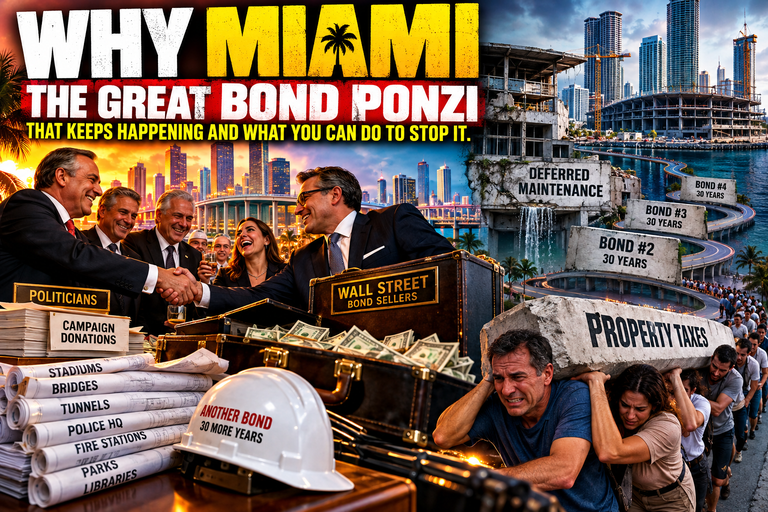
Miami-Dade has perfected a remarkable financial trick: Spend the taxpayers’ money, neglect the infrastructure, borrow hundreds of millions to repair what should have been maintained, and leave the next generation paying the bill. Then repeat the process.
And the most remarkable part? They get the voters to approve it.
It’s a beautiful arrangement if you’re a politician, a municipal bond underwriter, a financial adviser, a construction contractor, or an investor collecting interest on government debt.
For the ordinary homeowner who has to pay the property taxes? Not so beautiful.
I call it the Great Miami-Dade Bond Ponzi.
Now, technically, municipal bonds are not Ponzi schemes. They are legitimate financial instruments, and cities have perfectly valid reasons to borrow money for major infrastructure projects.
But when a government continually borrows against tomorrow’s tax revenue to compensate for yesterday’s neglected responsibilities, something is fundamentally wrong.
It begins to resemble a financial merry-go-round where new borrowing helps governments avoid confronting the consequences of earlier spending decisions.
And because Miami keeps growing, the city has been fortunate enough to keep that merry-go-round spinning.
But growth is not a substitute for financial discipline.
And debt is not a substitute for responsible government.
The Government Credit Card Nobody Asked For
Imagine you’re running your household the way some politicians run a city.
Your roof starts leaking. You don’t fix it. Your plumbing develops problems. You ignore them.
Your electrical system gets older, your air conditioner breaks down, and your house slowly deteriorates.
Meanwhile, you keep spending money on everything else.
Five years later, the roof is collapsing, the plumbing needs replacing, and the electrical system is dangerous.
So what do you do? You take out a 30-year mortgage to repair everything you neglected. Problem solved!
Except you don’t change your habits. You continue ignoring maintenance.
Five years later, you borrow again. Then again. And again.
Eventually, you’re paying off several generations of repairs, while the house continues falling apart.
No sensible bank would consider this responsible household financial management.
Yet when a government does it, they call it a capital improvement program.
When politicians need another few hundred million dollars, they don’t describe it as paying for years of neglected maintenance.
They give it a wonderful name. Something like: Safe and Ready Miami.
Who could possibly be against safety?
Who doesn’t want firefighters to have proper facilities?
Who doesn’t want police officers working in a safe headquarters?
That’s precisely why this is such an effective political strategy.
You don’t ask voters whether city government has managed their money responsibly.
You ask them whether they support police officers and firefighters.
And suddenly, questioning another $450 million in government borrowing becomes politically inconvenient.
That is not an accident. That is how the system works.
Miami-Dade Wants Another $450 Million
On November 3, 2026, City of Miami voters will decide whether to authorize another $450 million in general obligation bonds.
The proposal, called Safe and Ready Miami, would finance improvements to aging fire-rescue stations and construction of a new public safety headquarters.
The official ballot language promises no increase to the existing capital-project debt millage rate of 0.5935 mills.
But there is another phrase in that ballot question that taxpayers should pay very close attention to: “Payable from ad valorem taxes.”
That means property taxes. The city isn’t giving away $450 million.
It is borrowing money that must be repaid, with interest, through property-tax revenue.
That distinction matters enormously. Miami
Mayor Eileen Higgins has presented the proposal as a critical investment in public safety.
And perhaps some of those investments genuinely are necessary.
The city reports that its police headquarters, which opened in 1976, suffers from flooding, plumbing failures, roof leaks, broken restrooms, and outdated electrical systems.
Several Miami fire stations are more than 50 years old.
Think about that.
Miami did not suddenly discover in 2026 that buildings constructed half a century ago would require major maintenance.
These problems developed over years. City officials had budgets. They had departments. They had managers. They had consultants. They had inspectors. They had countless opportunities to plan ahead.
So where was the money?
Where was the maintenance reserve?
Where was the long-term replacement program?
Where was the financial discipline?
And why is borrowing another $450 million now being presented as the solution to problems that developed under previous city administrations?
Those are the questions Miami residents should be asking before voting.
The 2017 Miami-Dade Forever Bond: Remember That One?
This isn’t Miami’s first trip to the municipal borrowing buffet.
In 2017, Miami voters approved the $400 million Miami Forever Bond.
It was marketed as a transformational investment in the city’s future.
The money was intended for flood prevention, sea-level-rise resilience, roads, parks, public safety, cultural facilities, and affordable housing.
All worthwhile goals. All politically popular. And all wrapped in the irresistible language of making Miami a better place.
Now, nine years later, the city wants another $450 million.
That brings the combined authorization of these two programs to $850 million, assuming voters approve the new bond.
And that’s just the principal. It doesn’t include interest.
It doesn’t include every other financial obligation the city has undertaken.
And it doesn’t tell us how much of the earlier money has actually produced completed projects.
Before Miami voters authorize another bond, they deserve a complete, publicly accessible accounting of the previous one.
How much was actually borrowed?
How much was spent?
What projects were completed?
Which projects are behind schedule?
What happened to their original budgets?
How much interest have taxpayers paid?
And how much debt remains outstanding?
The city does publish information about the Miami Forever Bond, but taxpayers should not have to become forensic accountants to reconstruct the results of a $400 million public financing program. Miami
The standard should be simple: Before asking taxpayers for another $450 million, explain exactly what happened to the last $400 million.
Not in a glossy brochure. Not in a political commercial. In a detailed, independently audited report that any resident can understand.
And while we’re at it, let’s have the same report explain why deteriorating public safety facilities weren’t addressed through regular maintenance and long-term planning.
Because the real issue isn’t whether police officers deserve functioning buildings.
Of course they do.
The issue is whether city government deserves another enormous line of credit without first demonstrating that it can manage the money it already controls.
Follow the Money: Who Profits From These Bonds?
This is where the story becomes particularly interesting.
When Miami borrows hundreds of millions of dollars, the money doesn’t simply appear in a city bank account.
An entire financial industry is involved.
There are municipal bond underwriters, financial advisers, bond attorneys, accountants, investment firms, rating agencies, consultants, and other professionals.
They don’t work for free. Banks and underwriting firms can earn fees for arranging and selling bonds.
Law firms earn fees preparing transactions.
Financial advisers earn money structuring borrowing programs.
And investors purchase municipal bonds because they offer predictable interest payments, often with favorable federal tax treatment.
In other words, government debt is somebody else’s profitable business.
And the municipal bond industry has an obvious commercial interest in governments continuing to borrow.
The Municipal Securities Rulemaking Board even requires disclosures recognizing that an underwriter’s financial interests can differ from those of the government issuing the bonds. MSRB
Now ask yourself something. Who is sitting across the table from these financial institutions? Politicians.
Who approves the borrowing? Politicians and, when required, voters.
Who decides which financial professionals receive government business? The people managing the bond transaction through the city’s procurement and approval processes.
Who gets stuck making the payments? You, The taxpayer.
It is a system practically begging for conflicts of interest.
And that is why the relationships between politicians, financial institutions, lobbyists, political donors, and government contractors deserve serious scrutiny.
I’m not claiming every Miami politician is taking a kickback or that a specific bank has bribed anyone. That would require evidence.
But here’s what I am saying: When politicians can authorize enormous financial transactions involving private companies, while taxpayers remain responsible for decades of debt payments, the potential for political favoritism is enormous.
Every campaign contribution from a firm seeking municipal business deserves scrutiny.
Every underwriting contract should be publicly disclosed.
Every financial advisory fee should be published.
Every construction contract should be available for inspection.
And every politician approving these transactions should have to disclose relevant financial relationships.
There should be no mystery about who profits from government borrowing.
Because if the taxpayers are financing the party, they deserve to know who’s getting paid.
The Most Dangerous Words on the Ballot: “No Tax Rate Increase”
This is perhaps the cleverest part of the entire arrangement.
Miami’s $450 million bond proposal advertises that it will not increase the current debt millage rate.
That sounds wonderful.
But it does not mean the bond costs taxpayers nothing.
A millage rate is a tax rate applied to taxable property value.
For every $1,000 in taxable property value, one mill represents $1 in annual property tax.
Miami’s existing capital-project debt rate is 0.5935 mills.
Under that rate, a property with $300,000 in taxable value would generate approximately $178 in annual taxes for that particular debt levy.
The city’s proposal would keep the rate at or below that level.
That is a meaningful limitation, and taxpayers should understand it.
But they should also understand that a constant tax rate is not necessarily a constant tax bill.
If a property’s taxable value rises, the amount collected at the same millage rate can rise too, subject to applicable assessment limitations and exemptions.
And as the city’s overall tax base grows, the same millage rate can produce more revenue.
The bond also creates a long-term obligation against future tax collections.
So when politicians advertise borrowing without raising the millage rate, the proper response is not automatically to celebrate.
It is to ask: What happens to the existing debt?
When would the old debt have been paid off?
How long will the new debt extend these obligations?
How much will be paid in interest?
Could the millage rate have been reduced without the new borrowing?
And how much total property-tax revenue will be committed to debt service?
These are not unreasonable questions.
They are the questions any responsible household would ask before taking out another mortgage.
Yet somehow, when government borrows money, asking these questions is treated as an attack on public services.
The Interest: Where $450 Million Gets Expensive
Let’s put the size of the transaction into perspective.
Suppose Miami issues $450 million in bonds and pays an illustrative 5% annual interest rate over 30 years, with level annual debt-service payments.
The approximate numbers would be:
| Financial obligation | Amount |
|---|---|
| Original borrowing | $450 million |
| Illustrative interest rate | 5% |
| Repayment period | 30 years |
| Annual debt service | $29.3 million |
| Total repayment | $878 million |
| Total interest | $428 million |
That’s nearly $878 million to borrow $450 million.
And almost $428 million of that would be interest.
These are illustrative figures, not Miami’s official financing projections. The actual cost will depend on interest rates, bond maturities, issuance schedules, and repayment structure.
But the example demonstrates why taxpayers need to look beyond the headline borrowing amount.
A $450 million bond is not necessarily a $450 million obligation.
It can ultimately cost considerably more.
And while politicians can describe the projects they intend to construct, the taxpayer is left financing those projects long after the officials who approved them have left office.
That is the political genius of long-term government debt.
The politicians get the ribbon-cutting ceremony today. The taxpayers get the bill tomorrow.
The Real Scandal Is Deferred Maintenance
Let’s return to Miami’s police headquarters. The building opened in 1976. That makes it approximately 50 years old.
The city now describes serious flooding, plumbing problems, and failing infrastructure.
The city also says the headquarters was designed for approximately 560 officers but now accommodates roughly 1,390 sworn personnel and 400 additional staff members. Miami
Clearly, the building faces real problems. But these problems raise a much bigger question.
How did city management allow the situation to deteriorate so badly?
Miami has experienced tremendous economic growth. Real estate values have increased enormously.
Development has transformed entire neighborhoods.
New luxury towers, hotels, office buildings, and residential developments have expanded the city’s tax base.
Yet the government now needs to borrow hundreds of millions to address aging public safety facilities.
Where did the benefits of that growth go? That is the question taxpayers should be asking.
Consider the difference between routine maintenance and complete replacement.
A roof repaired at the appropriate time might last many more years.
A neglected roof can cause water damage, mold, electrical problems, structural deterioration, and expensive interior repairs.
A relatively manageable expense can become a major capital project.
And once that happens, city officials can claim that borrowing is unavoidable.
But unavoidable today does not mean the problem was unavoidable ten years ago.
Deferred maintenance is not a financing strategy. It is often the accumulated cost of poor planning.
Governments should maintain reserve funds, conduct facility inspections, establish replacement schedules, and account for the depreciation of public assets.
A city should know when its buildings, vehicles, equipment, and infrastructure will require major rehabilitation.
These are not extraordinary management concepts. They’re basic responsibilities.
And when officials neglect them, taxpayers eventually pay. Sometimes twice.
First through the taxes that should have supported proper maintenance.
And again through the borrowing needed to repair the resulting damage.
The Endless Cycle: Borrow, Build, Neglect, Repeat
This is what makes Miami’s situation so troubling.
The city can always point to another legitimate need.
Another aging building. Another drainage problem. Another road. Another public facility. Another emergency.
And because those needs are real, borrowing can always be presented as reasonable.
But there must be a point where taxpayers ask whether the underlying financial model is sustainable.
Consider a simplified example.
A city borrows $400 million for infrastructure improvements.
Ten years later, it borrows another $450 million for additional facilities.
Several years later, it discovers that other assets have deteriorated and need hundreds of millions more.
Meanwhile, some of the original debt remains outstanding.
Each new borrowing program generates additional interest obligations.
And each new administration inherits financial commitments made by previous administrations.
Eventually, a substantial portion of future revenue can become committed before the budget process even begins.
That’s the danger. Not that every bond is bad. Not that every capital project is unnecessary.
But that governments can develop a permanent dependence on borrowing instead of maintaining financial discipline.
Miami’s continued economic growth can make that dependence easier to sustain.
Rising property values and new development help expand the tax base.
But what happens when growth slows?
What happens when property values stagnate?
What happens when insurance expenses rise faster than incomes?
What happens when construction costs soar?
What happens when another recession arrives?
The debt doesn’t magically disappear.
The bondholders still expect payment.
That is when the weaknesses in the model become painfully obvious.
A growing tax base can conceal bad financial habits for years. It cannot make those habits disappear.
And Don’t Forget Who Is Really Paying
Politicians often discuss municipal debt as if government were some independent financial entity.
They say the city is borrowing. The county is investing. The government is paying.
But governments don’t generate money out of thin air.
Ultimately, their resources come from taxpayers, ratepayers, fees, and other revenues.
When government borrows against future property-tax collections, it is committing future public money.
And property taxes affect far more people than homeowners.
Landlords pay property taxes. Businesses pay property taxes. Commercial properties pay property taxes.
And those expenses influence the cost of housing, goods, services, and commercial rents.
A renter may never receive a property-tax bill directly, but that doesn’t mean property taxes have no effect on rent.
A restaurant owner may not own the building, but property-tax expenses can still affect occupancy costs.
A small business operating on thin margins cannot simply ignore rising government costs.
Ultimately, these costs circulate through the entire local economy.
And in a city where housing affordability is already a serious concern, that matters.
Miami cannot continue talking about affordable housing while ignoring the cumulative financial burden government places on property owners and businesses.
Amendment 3: A Different Kind of Protection
That brings us to another major question on Florida’s November 3 ballot.
Amendment 3 would substantially increase Florida’s homestead exemption for non-school property taxes.
Under the proposal, the exemption would increase to $150,000 in 2027 and $250,000 in 2028, with inflation adjustments afterward.
The amendment would also reduce the annual assessment-growth cap for non-homestead property from 10% to 5%.
It would impose additional restrictions on how counties and municipalities use property-tax revenue.
These are significant proposed changes.
Supporters argue that Florida homeowners need protection against escalating property-tax burdens.
Opponents argue that reducing local government revenue could threaten public services or shift costs elsewhere.
But one particularly important provision deserves attention.
Amendment 3 would still permit property-tax revenue to be used for bond debt service.
In other words, the constitutional amendment is not a magic eraser that eliminates existing municipal debt obligations. BallotReady
Even major property-tax reforms cannot simply make decades of government borrowing vanish.
That is why voters need to examine tax policy and borrowing policy separately.
One concerns how government collects revenue. The other concerns how government commits future revenue.
Both matter.
And neither should become an excuse for ignoring responsible budgeting.
The Most Revealing Ballot Question May Be the Second One
There’s something particularly interesting about Miami’s November election.
The $450 million bond isn’t the only referendum involving municipal borrowing.
Miami voters will also decide whether to establish a permanent advisory General Obligation Bond Oversight Committee.
The proposed committee would monitor and publicly report on active bond-funded capital projects, including project costs, timelines, status, and available funds. Miami
Think about what that tells us.
The city is asking for another $450 million while simultaneously asking voters to approve an additional structure for monitoring its bond programs.
Transparency is welcome. Oversight is necessary.
But why does adequate financial transparency require a new political initiative?
Shouldn’t comprehensive project reporting already be a fundamental responsibility of city government?
Shouldn’t residents already know how much of every bond has been issued, spent, and repaid?
Shouldn’t project cost overruns already be readily visible?
Shouldn’t taxpayers already receive regular financial performance reports?
And perhaps most importantly, why would oversight be merely advisory?
A committee that can publish information is useful.
A committee that can identify financial problems is better.
But an oversight structure without meaningful authority to compel corrective action may accomplish little beyond producing more reports.
Miami needs accountability with consequences. Not simply another committee.
The Problem Isn’t Just Miami
Miami is an especially visible example of a broader problem.
Across Florida, taxpayers are increasingly being asked to approve borrowing programs, infrastructure financing measures, special assessments, and extensions of existing property taxes.
Some are necessary. Others deserve considerable scrutiny.
The pattern often looks familiar. Government revenue grows. Government spending expands. Infrastructure problems accumulate. Officials identify major capital needs.
Then voters are asked to approve new financing.
A particularly important distinction is whether governments are borrowing to construct new, long-lived assets or to address maintenance problems that should have been funded through existing budgets.
Building a bridge that will serve the public for 50 years can be a reasonable reason to issue long-term bonds.
Borrowing for decades to address maintenance that should have been performed years earlier raises very different questions.
The difference matters. So does the distinction between a genuine one-time capital expense and an ongoing operating expense disguised as an investment.
A government that repeatedly finances predictable costs with long-term debt risks spending tomorrow’s revenue to avoid making difficult decisions today.
And that is how the cycle perpetuates itself.
Why Politicians Love Borrowing
The political incentives are almost too obvious. Imagine you’re an elected official. You have two choices.
The first is to tell voters that the government must reduce spending in some areas, redirect existing revenue, and establish a disciplined maintenance program.
That means confronting departments, contractors, political supporters, and competing priorities.
It means making unpopular decisions.
It means explaining why projects cannot all be funded immediately.
The second choice is to announce a magnificent new investment program.
Hundreds of millions of dollars. Modern facilities. New construction. Improved public safety. Better services. Press conferences.
Architectural renderings. Construction ceremonies. Ribbon cuttings.
And perhaps a plaque with somebody’s name on it.
Which one do you think is more attractive politically?
Borrowing allows politicians to deliver visible benefits now while spreading the financial cost across future taxpayers.
Some of those taxpayers aren’t even old enough to vote.
Others haven’t moved to Miami yet.
And many of the officials responsible for the borrowing will be retired or pursuing other offices long before the last bond payment is due.
That is the fundamental political problem with excessive municipal borrowing: The people making the commitments are often not the people who must live with their long-term consequences.
What Miami Residents Can Do to Stop the Cycle
It’s easy to complain about government spending.
It’s harder to create a system that discourages waste and demands accountability.
But the solutions aren’t particularly complicated.
Miami could begin by adopting several basic principles.
1. Full disclosure before additional borrowing. Every major bond proposal should be accompanied by a public accounting of existing debt, outstanding principal, interest obligations, repayment schedules, and project performance.
2. Mandatory infrastructure maintenance reserves. Essential maintenance should be funded annually instead of postponed until deterioration becomes a crisis.
3. Independent audits that examine performance, not merely accounting compliance. It isn’t enough to determine whether money was spent legally. Taxpayers need to know whether projects were delivered efficiently and whether the spending produced the promised results.
4. Complete transparency regarding financial beneficiaries. Bond underwriting fees, advisory contracts, legal expenses, procurement decisions, and relevant political relationships should be disclosed in a format ordinary residents can understand.
5. Public reporting on every bond-funded project. Residents should be able to see original budgets, revised budgets, expenditures, completion percentages, and delays without filing public-records requests.
6. Stronger accountability for preventable deterioration. When facilities fall into disrepair because maintenance was repeatedly deferred, taxpayers deserve an explanation of who made those decisions and why.
7. A long-term debt management policy. New borrowing should be evaluated against existing obligations, projected revenue, economic downturn scenarios, and future infrastructure requirements.
None of these measures prevents Miami from investing in public safety.
None requires abandoning necessary infrastructure projects.
And none prevents responsible borrowing.
They simply require the government to demonstrate that it has managed existing resources properly before demanding more.
That is not an unreasonable standard.
It is the minimum standard taxpayers should expect.
The Question Every Miami Taxpayer Should Be Asking
Forget the political slogans for a moment. Forget the glossy promotional materials. Forget the emotional appeals.
And ask one straightforward question. Where did all the money go?
Miami has benefited from extraordinary economic development.
Its skyline has transformed.
Its real estate market has attracted investors from around the world.
Its international reputation has grown.
Billions of dollars have been invested in the city.
Yet taxpayers are being asked to authorize hundreds of millions more in borrowing to repair deteriorating public facilities.
There may be legitimate financial explanations for some of that.
Public safety costs money. Construction is expensive. Buildings age. Infrastructure needs replacement.
Nobody disputes those facts.
But none of them excuses the government from demonstrating responsible financial management.
And none should prevent taxpayers from demanding explanations for years of deferred maintenance.
The question isn’t whether Miami needs functioning fire stations. It does.
The question isn’t whether police officers deserve a suitable headquarters.
They do.
The question is why these essential needs have reached this condition, whether existing resources were managed appropriately, and whether the proposed financing represents the most economical solution.
Those are the questions that deserve answers.
Not after the election.
Before it.
The Great Miami Bond Ponzi
Here’s the uncomfortable truth.
Municipal borrowing can be an extraordinarily useful tool.
But it can also become an extraordinarily convenient way for government to avoid financial discipline.
As long as property values increase, development continues, and taxpayers keep approving additional debt, officials can continue funding projects without fully confronting the costs of previous decisions.
The financial industry earns its fees.
Investors collect their interest.
Contractors receive new projects.
Politicians announce new investments.
And taxpayers inherit the obligations.
Around and around it goes.
The system doesn’t require an actual Ponzi scheme to produce some of the same troubling incentives: dependence on continued revenue growth, ever-present pressure to borrow, and the transfer of financial burdens into the future.
Miami has been fortunate.
The city has enjoyed remarkable growth.
But fortune is not financial management.
And taxpayers should never confuse the ability to borrow money with the ability to manage it responsibly.
The true measure of a well-run city isn’t how much money its politicians can borrow.
It’s how effectively they manage the money they already have.
Before Miami takes on another $450 million in obligations, residents deserve a convincing answer to a very simple question:
Why should we trust the same political system that allowed these facilities to deteriorate to manage another enormous borrowing program?
Maybe the city has a good answer.
Then it should provide the evidence.
Publish the numbers.
Show the contracts.
Explain the maintenance failures.
Account for the previous bonds.
Disclose the full long-term financing costs.
And let residents judge the results.
Because this isn’t Wall Street’s money.
It isn’t the mayor’s money.
It isn’t the commissioners’ money.
It’s your money.
And long after today’s politicians have left office, Miami residents could still be paying the interest.
That’s the Great Miami Bond Ponzi.
And the only way to break the cycle is to stop giving government a blank check and start demanding real accountability.
Miami doesn’t need another clever slogan.
Miami needs a government that understands the difference between borrowing money and managing money.
And taxpayers deserve nothing less.
Final Note:
I can’t give you the exact numbers – I don’t know if anyone knows the updated real number but as of September 30, 2024 Miami-Dade had approximately $20.5 billion in outstanding bonds and loans. I am sure that it is a lot higher today and that is how Cities and Counties go bankrupt or keep looking for more inventive ways to raise more taxes.
