
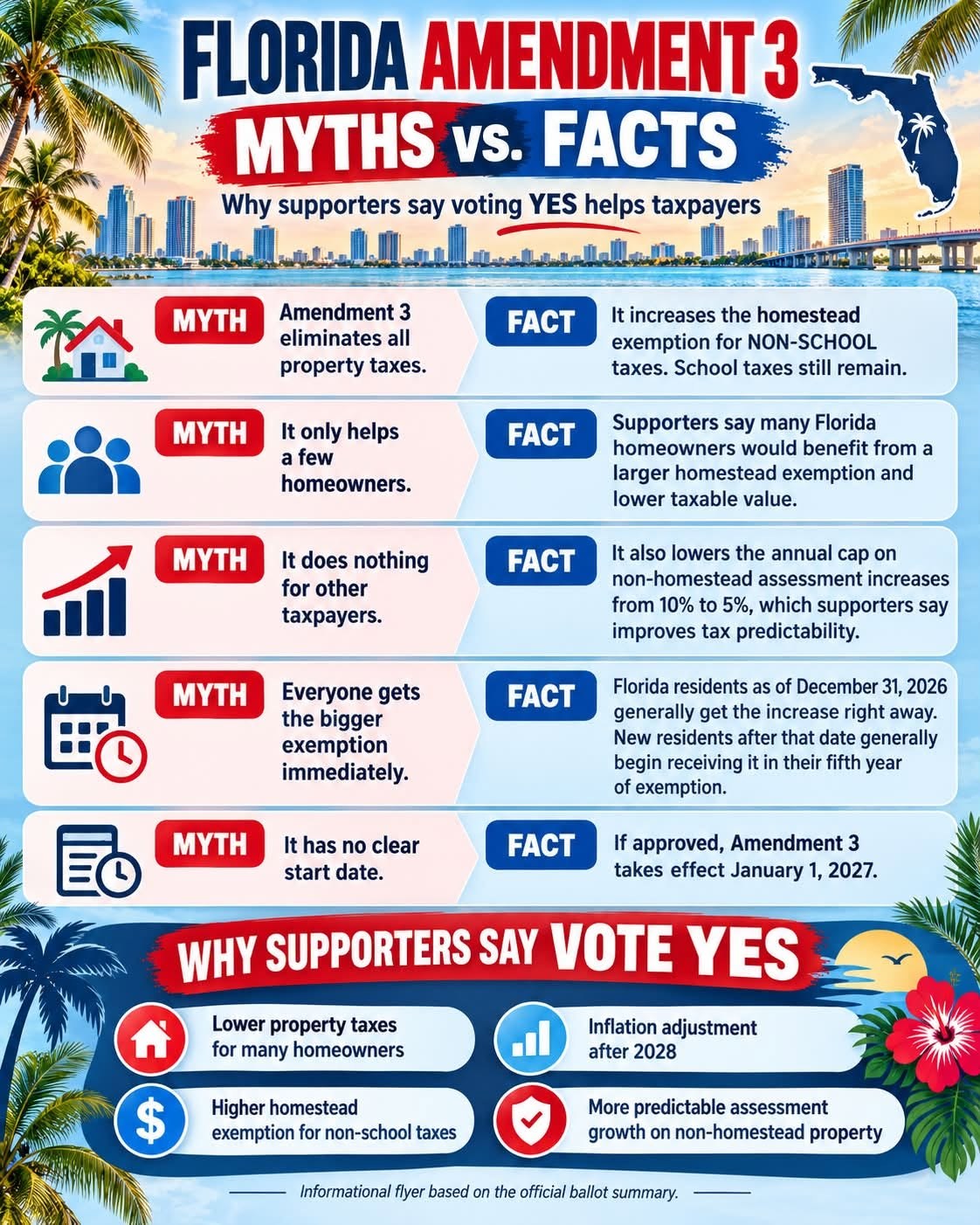
When Miami-Dade voters open their ballots on Tuesday, November 3, one of the most consequential choices will not be a candidate at all. Amendment 3, placed on the ballot by the Florida Legislature, would deliver the biggest homestead property tax cut in state history — and it takes 60 percent of the vote to pass.
Property taxes are the kitchen-table issue in Miami. Between insurance premiums and tax bills, the cost of simply staying in your own home has climbed relentlessly. Amendment 3 is the state’s answer. Here is what it actually does, and what it does not do.
What Amendment 3 Actually Does
The amendment raises the homestead exemption for all non-school property taxes to $150,000 in 2027 and $250,000 in 2028. After 2028, the exemption adjusts for inflation every year.
That is a dramatic jump from today’s exemption of roughly $50,000. According to Florida TaxWatch, a homestead assessed at $150,000 or less in 2027 — or $250,000 or less in 2028 — would owe nothing at all to the county, the city or special districts. School taxes would still be owed, because Amendment 3 does not touch them.
The amendment also requires the Legislature to set up a uniform procedure allowing counties and cities to raise the exemption even further, up to the full assessed value of the home. Special districts could do the same with voter approval in a referendum.
For rentals, second homes and commercial property, Amendment 3 cuts the annual cap on assessment increases from 10 percent to 5 percent. Landlords and business owners would get something homeowners have had for decades: predictability.
If approved, Amendment 3 takes effect January 1, 2027. The first tax bills reflecting the change would arrive in November 2027.
Myths vs. Facts
Myth: Amendment 3 eliminates all property taxes. Fact: It increases the homestead exemption for non-school taxes only. School taxes still remain, and the existing $25,000 school exemption stays exactly as it is.
Myth: It only helps a few homeowners. Fact: Supporters point out that the exemption applies to every homesteaded property in Florida. With the exemption rising to $250,000 in 2028, a large share of Miami-Dade homeowners would see most — or all — of their non-school tax bill disappear.
Myth: It does nothing for other taxpayers. Fact: The 5 percent cap on non-homestead assessment increases covers rental homes, second homes and businesses. Supporters say that means more predictable taxes for landlords and employers, and less pressure to pass sudden assessment spikes on to renters.
Myth: Everyone gets the bigger exemption immediately. Fact: Floridians who are residents as of December 31, 2026 generally get the increase right away. People who move to Florida after that date start with the existing exemption, and the increased exemption begins in their fifth year of exemption.
Myth: It has no clear start date. Fact: The amendment takes effect January 1, 2027, with the $150,000 exemption applying that year and the $250,000 exemption in 2028.
The Fine Print Voters Should Know
Amendment 3 also restricts what local governments can do with the property taxes they still collect. Counties and municipalities would have to use property tax revenue solely for public safety, education and schools, infrastructure, natural resources, bond debt service, employee retirement benefits, and operations and administration.
The measure has heavyweight backing. Governor Ron DeSantis called the special session that put it on the ballot, and the Republican Party of Florida has formally endorsed it, along with Byron Donalds, Senator Ashley Moody, Senator Rick Scott and CFO Blaise Ingoglia.
The bar, however, is high. Florida constitutional amendments need 60 percent — not a simple majority. A measure can win most of the vote and still fail, so every ballot counts.
Before You Vote Tuesday
Polls are open from 7 a.m. to 7 p.m. on Tuesday, November 3. If you are in line at 7 p.m., you can still vote. Check your sample ballot and your assigned precinct before you go — a number of Miami-Dade precincts have been temporarily relocated for this election.
However you vote on the candidates, do not skip the amendments at the bottom of the ballot. For Miami homeowners, Amendment 3 may be the most expensive decision on the page.
