
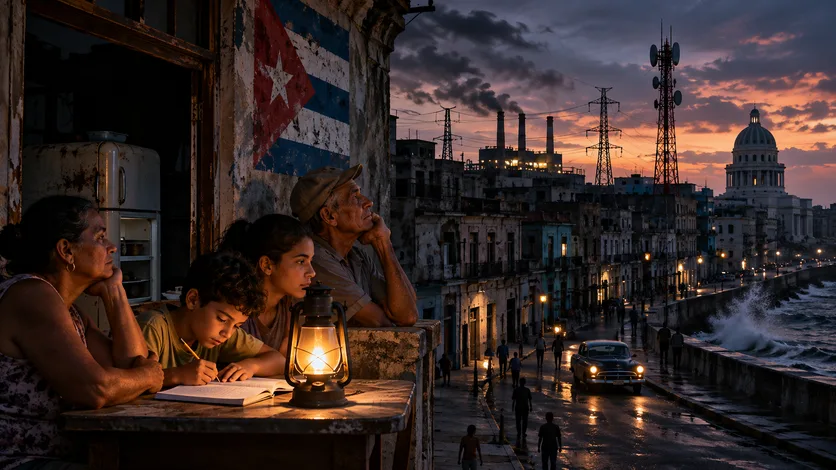
Tomorrow, across Miami, ovens will run all day. Turkeys will roast, cafeteras will hiss, and somebody’s abuela will complain — correctly — that the house is too hot with the air conditioning fighting the oven.
Ninety miles south, Cuba’s families will plan Thanksgiving the way they now plan everything: around the blackout schedule. When will the power come? How long will it stay? Can the food in the refrigerator survive another night without it?
That contrast is not an accident, and it deserves to be said out loud in this city, because Miami is the other half of this story.
The island’s grid is collapsing in slow motion. Cuba’s big power plants are decades old, built with Soviet help and patched ever since. The country has suffered repeated nationwide grid collapses, and in many communities electricity now arrives for a few hours between long stretches of darkness. Americans averaged about 11 hours of power interruptions in all of 2024 — hurricanes included. Cuban families can get that in a single day.
This month, the crisis got a symbol. In 2019, Cuba had to rent floating power plants — generating stations on Turkish ships — because its own grid could no longer be trusted. At their peak they supplied nearly a quarter of the island’s electricity. But the ships belonged to someone else, and Havana couldn’t pay the bill. On November 2, the Erol Bey weighed anchor and left Havana Harbor. When your power plant can sail away, you do not have an energy policy. You have a hope.
Then there is the phone in every Cuban pocket — and the toll booth on it. All of Cuba’s telecommunications run through one state company, ETECSA. There is no competitor, no alternative, no choice. Last year ETECSA restricted ordinary top-ups and pushed data packages costing more than a month’s minimum wage — prices that only make sense if you understand who actually pays them: the families in Hialeah, Little Havana and Kendall who recharge their relatives’ phones from here. Havana has figured out how to tax Miami’s love for its own people, and it collects in dollars.
The same monopoly decides what Cubans may read and say online. Websites are blocked, networks have been shut down during protests, and Cubans have gone to prison for Facebook posts. The fiber-optic cables under the sea work fine. It is the freedom that doesn’t reach the island.
Here is the part Miami understands in its bones. The difference between this city and that island is not talent. The engineers, doctors and electricians who keep South Florida running include thousands of Cubans who crossed the same sea. Given the same people, one system produces Miami and the other produces a blackout schedule. The variable is not the Cuban. It is the system the Cuban lives under.
The embargo debate will go on, as it should — sanctions are a real factor and honest people argue about them. But no embargo ordered Havana to keep a telecom monopoly, to jail a man for a post, or to let forty-year-old power plants rot while the billboards stayed freshly painted. Those were choices, made by a government that has never once had to win a customer’s business or a voter’s honest consent.
So tomorrow, when the lights are on and the oven is hot and the video call to the island connects — if the power is on at the other end — spare a thought for what those ninety miles really measure. Not distance. Consequences.
Miami is what Cubans build when they are free. Cuba is what gets built when they are not.
