
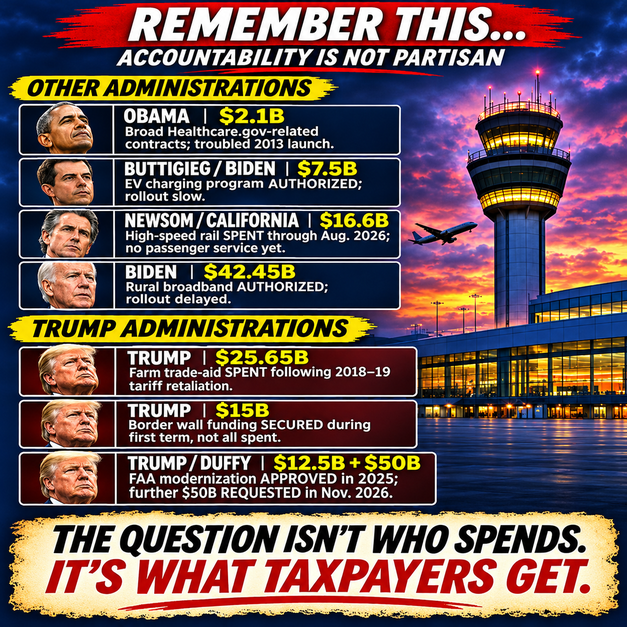
Adapted from “REMEMBER THIS… The Problem Isn’t Government Spending. It’s What We Get for Our Money” on In Search of Your Passions.
There is an old saying in business: it doesn’t matter how much money you spend. What matters is what you get for it.
Apparently nobody explained that to Washington — and South Florida pays for it like everybody else. When the nation’s air traffic control system suffered a major nationwide communications failure on November 13, flights were disrupted by the thousands, and Miami International — one of the busiest airports in America — felt it the same day. Now the Transportation Secretary is asking Congress for another $30 billion to modernize air traffic control. After the failure, he pushed the number as high as $50 billion.
Before anybody signs that check, let’s look at what we usually get for our money.
The Receipts So Far
Remember Healthcare.gov? When the Obamacare website launched in 2013, people couldn’t register, the system crashed, and applications failed. One analysis put the cost of the website and related systems at roughly $2.1 billion — for a site whose basic job was to let people sign up. It was eventually repaired, but nobody was held financially responsible for delivering a system that wasn’t ready.
Then there was the electric vehicle charging program: $7.5 billion authorized in 2021 to build out America’s charging network. By 2024, only a handful of federally funded stations had opened under the main program. By June 2026, about 183 stations. Five years, billions authorized, and the buildout is still nowhere near the scale that was promised.
California’s high-speed rail is the masterpiece of the collection. Voters approved it in 2008 at an estimated $33 billion. More than $16 billion has been spent, cost projections for the full system now run past $100 billion — and not one paying passenger has taken a high-speed trip. Bridges and guideways exist. The railroad doesn’t.
Rural broadband got $42.45 billion in 2021. The program then spent years working through state plans, eligibility rules, environmental requirements, and permitting. Actual federally funded household connections only began in 2026 — by which time satellite internet had transformed the market the program was designed for. Sometimes the technology changes faster than Washington can complete the paperwork.
And foreign aid through USAID — roughly $273 billion over ten years — raises the same questions as every domestic program: What is the objective? Who benefits? How much reaches the intended recipients, and how much stops with administrators, contractors, and consultants along the way?
Now the FAA Wants Its Turn
Does air traffic control need modernization? Absolutely. Much of the system was designed decades ago; the equipment is obsolete and patched on top of patched. Miami’s travelers deserve better than a system held together with spare parts.
But Congress already provided $12.5 billion in 2025 for this modernization. Democratic lawmakers note that only about $1 billion of it has actually been spent. The Secretary argues the rest is committed to specific projects. Both claims deserve answers.
Here’s the one that matters most: in September 2026, the Government Accountability Office reported that the FAA had not developed a comprehensive, well-documented lifecycle cost estimate for the new modernization initiative. We are discussing tens of billions of dollars, and there is still no complete accounting of what the whole project will cost. Over the past 30 fiscal years, the FAA has received roughly $490 billion in funding under presidents of both parties. The central question nobody has answered: how much of that was specifically spent replacing the obsolete systems, and what exactly did we get?
It’s Not Always the Contractors
One thing people get wrong: it’s not always contractors cheating the government. Sometimes the government makes everything more expensive all by itself.
I spent years doing government contract work — a major IT contract with the U.S. Postal Service, work for the State of Florida, and local governments — back when I owned my computer company. I learned quickly that I had to charge government customers at least 30 percent more than private businesses just to cover the added costs and risks.
The government pays slowly — “net 30” often means 45 to 60 days while you’re covering payroll and equipment out of your own pocket. Agencies change requirements mid-job, or cancel after you’ve committed real resources. On one contract involving four truckloads of mainframe computers, the government office changed its mind halfway through the move. A $20,000 contract became a $10,000 contract. My expenses did not drop by half.
Add the specifications, paperwork, reporting, and compliance costs, and that 30 to 50 percent premium starts to look less like greed and more like survival. The government frequently creates the very inefficiencies it later blames on private contractors. And who ultimately pays? We do.
Miami-Dade County writes big checks too — transit, seaport, airport expansions — and the same standard should apply at County Hall as in Congress: the question is never just how much was spent. It’s what we got.
What We Should Demand
The rules aren’t complicated. Every major project should have clearly defined objectives before funding is approved, a realistic budget with independent estimates, published milestones and completion dates, and every dollar traceable from appropriation to expenditure. Independent auditors should evaluate actual results, not press releases. Contractors should be paid under enforceable agreements, with real consequences for failures under their control. Significant overruns should trigger a mandatory independent review before one more dollar is approved.
And before Congress funds another multibillion-dollar project, it should review the performance of the similar projects it already paid for.
The Bottom Line
America needs infrastructure. We need reliable air traffic control, highways, bridges, airports, and communications networks — and yes, those things cost money. The question was never whether we should spend. The question is whether we are purchasing something of value.
Spending $10 billion doesn’t mean you accomplished $10 billion worth of work. Announcing a program isn’t delivering a program. Appropriating money isn’t spending it, and spending it isn’t producing results.
A billion dollars doesn’t become more valuable because a Republican spent it, or less valuable because a Democrat spent it. It’s the same billion dollars, from the same taxpayers. Hold both parties, every agency, and every contractor to the same standard:
Show us the money. Show us the work. Show us the results.
— YNOT
