
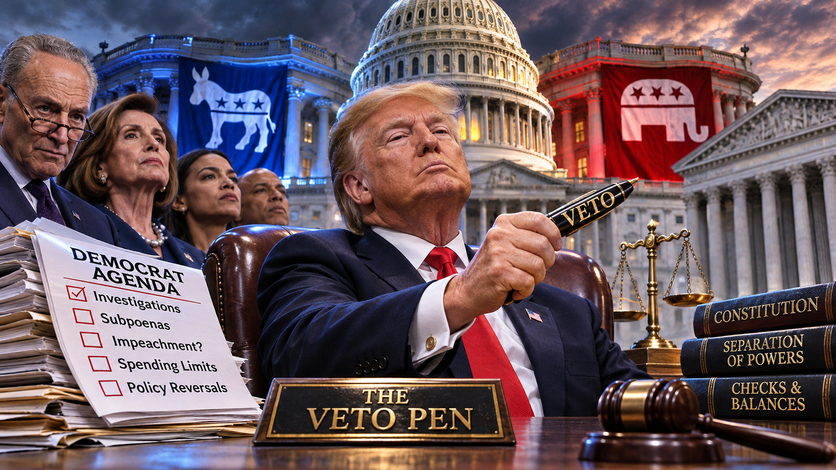
Editorial — The Miami Metropolis, November 5, 2026. Adapted from “SO WHAT HAPPENS NEXT? Trump vs. the Democrat Congress” by YNOT at In Search of Your Passions.
Florida woke up Wednesday morning as an island. The Blue Wave that swept Democrats into control of both the House and the Senate on Tuesday night broke against the Sunshine State and stopped: Florida stayed red, elected Byron Donalds governor, kept Ashley Moody in the U.S. Senate, and sent Debbie Wasserman Schultz back to Washington. Miami now gets a front-row seat to the strangest show in American politics — a Democratic Congress determined to humble a president who still holds the veto pen, the executive branch, and absolutely no intention of being humbled.
So what happens next? Less than the victory speeches promise, and more than the losers fear. Here is the part the celebrations left out: the Democrats won Congress. They did not win the presidency. And in America, that distinction is about to run the country for two years.
The Blue Wave Meets the Red Stop Sign
The numbers from Tuesday were not subtle. Democrats flipped at least seven Republican Senate seats — Iowa, Kansas, Ohio, Maine, North Carolina, South Carolina, and, astonishingly, Texas, which elected Democrat James Talarico. Kansas chose a Democratic senator for the first time in nearly a century. As of this morning, Democrats hold at least 54 Senate seats, and House control is assured.
The response from the new majority was immediate. Representative Robert Garcia, the incoming ranking Democrat on House Oversight, delivered a two-word message to the Trump administration: “Lawyer up.” Others suggested Trump officials clear their calendars for subpoenas. Senator Ed Markey joked the paper demand might require planting forests.
But under the confetti sits an unforgiving piece of arithmetic. Most legislation needs 60 votes to clear the Senate filibuster, then the president’s signature. Trump can veto anything. Overriding him takes two-thirds of both chambers — 67 Senate votes. The Democrats do not have anything close to 67. They can investigate, block nominees, control committees, and make the president’s life miserable. What they cannot do is legislate his agenda out of existence. The captain’s crew voted to throw him overboard; the captain still controls the engine room.
President Mr. Veto
Trump, characteristically, has already explained his strategy on Fox News: send him unacceptable bills and he will veto them; after a few months of frustration, Democrats will come looking for a deal. First refuse, then wait, then negotiate, then announce the agreement was his idea all along. It is less a governing philosophy than a business plan, but it has the advantage of being constitutionally sound.
There is a second asymmetry Miami should note. Trump cannot run again in 2028 — the Twenty-Second Amendment sees to that. He is negotiating over his legacy. Democrats are negotiating over their political future, and a politician who needs the next election usually has more to lose than one who does not. The man with nothing to lose holds the pen.
The Ghost of Newt Gingrich
We have seen this movie. In 1994, Newt Gingrich’s Republicans swept Congress and charged at Bill Clinton. The result was two government shutdowns, a public that blamed Republicans for the mess, and then — the part everyone forgets — actual governing: welfare reform, a balanced budget in 1997, and federal surpluses. Then House Republicans impeached Clinton in 1998, the Senate acquitted him, Democrats gained House seats, and Gingrich was gone.
The lesson was not that investigations are improper. The lesson was that power becomes a liability when voters conclude it is being used for revenge instead of governing. Democrats now face the same fork in the road. A third impeachment of Trump is arithmetically possible in the House and arithmetically doomed in the Senate, where removal needs the same 67 votes they do not have. Subpoenas face the same wall: Congress can issue them, but enforcing them against a resistant administration runs through Trump’s own Justice Department and years of court fights. Hearings can move public opinion. They cannot lower a grocery bill in Hialeah.
Where the Real Power Sits
The Democrats’ genuinely dangerous weapon is quieter: the Senate confirms — or refuses to confirm — cabinet secretaries, judges, and ambassadors. Starting January 3, 2027, every Trump nominee runs a Democratic gantlet, and there is no veto for a nomination that never gets a vote. If a Supreme Court seat opens, expect Washington to rediscover the Merrick Garland precedent, this time aimed the other direction.
And before any of that, there is a lame-duck window. Republicans hold Congress until January 3, and the current federal spending deal expires December 11. What the outgoing Congress funds — or refuses to fund — will shape the first fights of 2027, including the shutdown standoff both parties are already rehearsing.
What It Means Down Here
For South Florida, the practical questions are local ones. Immigration enforcement — funded in large part by money already appropriated in 2025, beyond the reach of a quick congressional cutoff — will be the loudest battlefield, and Miami will hear it loudest. Wasserman Schultz returns to a House majority promising oversight; Florida’s Republican statewide winners return to a state government that just defied the national tide. The deal space, if any exists, sits where both parties already agree more than they admit: drug prices, trade, infrastructure, permitting.
So who has the advantage? The Democrats have the momentum, the mandate, the committees, and the confirmation calendar. Trump has the presidency, the veto, the agencies, and an agenda already enacted and funded. The Democrats won the right to challenge him. They did not win the ability to govern without him.
The final verdict belongs, as always, to the audience. Voters did not hire Congress to produce two years of televised warfare; they hired it because explanations do not pay grocery bills — a truth Miami’s working families understand better than anyone in Washington. The party that remembers that first wins 2028. The party that forgets it will learn, again, what happened to Newt Gingrich.
Adapted from the original essay at In Search of Your Passions: https://insearchofyourpassions.com/2026/11/05/so-what-happens-next-trump-vs-the-democrat-congress/
