
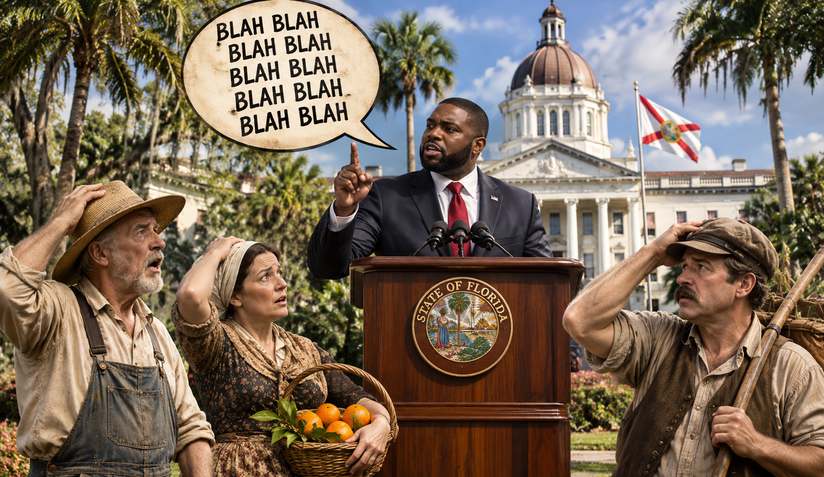
Now, Florida has gone and elected itself a new governor, and half the state is walking around asking the same question it asks every four years, generally while stuck in traffic: Who is this fellow, and what have we done?
His name is Byron Donalds. The newspapers, in their excitement, keep calling him Governor Blah Blah Blah— not out of disrespect, but because a governor, before he has governed, is mostly talk. Blah is the sound a promise makes before it has met a legislature. So let us examine the man while he is still made entirely of words, because words are all we have bought so far — and we paid handsomely for them. The gentleman raised a war chest well north of a hundred million dollars, which is a lot of money to spend learning one man’s name, and on November 3rd he won the office by about a point and a half — 50 percent to David Jolly’s 49, give or take the width of a gator’s whisker. Close enough that half of Florida is celebrating and the other half is checking the price of houses in Georgia.
What Does He Believe In?
Governor Blah believes, first and foremost, in the gospel according to his two political fathers: Donald Trump, who endorsed him early and rallied for him in Daytona Beach, and Ron DeSantis, whose policies he has promised to continue the way a railroad continues — same track, same direction, no switches thrown.
He believes the government that governs least is the one that has read the Florida constitution, which keeps the state income tax at exactly zero dollars, a figure he intends to defend with his life, or at least with his veto pen. He believes education money should follow the child rather than the building, that a parent knows more about a child’s schooling than a committee does, and that the state universities have wandered off into ideological weather he means to march them out of. He believes a business in Florida should have to check whether its workers are in the country legally — all of them, through E-Verify — and that a man has a right to defend his home with more than harsh language.
Underneath all of it, he believes a thing that is almost old-fashioned enough to be radical: that Florida works, that it is the envy of the colder and more heavily taxed states, and that his job is not to fix it but to keep the rest of the country’s troubles from moving here — a sentiment every Floridian who arrived with a U-Haul already agrees with, having personally conducted the experiment.
What Has He Done?
Here the record gets shorter, as records do when a man is 48 years old and spent most of his working life in the finance business in Naples rather than in the marble halls. What he has done is climb, steadily and without once falling off the ladder, which in politics is a talent all by itself.
He served two terms in the Florida House, then two terms in the United States Congress representing Southwest Florida — a congressman of the outspoken variety, the kind television producers keep on speed dial. He has never run a state, a city, or — so far as the record shows — a lemonade stand with more than one employee. Florida has hired a man to run a government of some hundred thousand souls and a budget north of a hundred billion dollars whose principal executive experience is having opinions about other people’s governing, delivered crisply, on camera.
In fairness — and fairness is a tax I pay only occasionally — the same could be said of most governors the week before they become governors. Abraham Lincoln’s résumé, had he applied for the job in a modern human-resources portal, would have been rejected by the software. And the gentleman makes history whether he wishes to or not: he is Florida’s first Black governor, and the first Black Republican elected governor anywhere in America, which is a considerable thing to have done before breakfast on your first day. He did it in a year when his party was losing nearly everywhere else on the map — the blue wave broke over America and somehow missed Florida entirely, the way hurricanes are supposed to do and so rarely cooperate.
What Does He Say He’s Going to Do?
Ah. Here the supply is plentiful; promises are the one crop that never fails in Florida.
He says he is going to make Florida affordable, which is the modern way of saying everything costs too much and something must be done, though the something is where men part company. His particular somethings: cut property taxes on the homes people actually live in — the voters just raised the homestead exemption themselves, to $150,000 next year and $250,000 the year after — and he says he will keep pushing until the tax on a family’s own home is a memory. He says he will defend the insurance reforms that limit lawsuits against the companies, keep the state-run insurer small, grade the insurance companies on a public scorecard like schoolchildren, and fine them for lying on their report cards, which — if enforced — would be the most entertaining spectator sport in Tallahassee.
He says every permit will be posted online with a deadline attached, like a train schedule, and major developments will go through one digital door instead of forty paper ones. He says your doctor will have to post cash prices for the fifty most common procedures — “Your Doctor, Your Price,” he calls it — so a man can learn what his appendix costs before it declares an emergency. He says every third grader will learn to read or be tutored free until he can, every government contract will be searchable by any citizen with a telephone, every agency will be audited every year, and the state’s efficiency squad — he calls it DOGE, after the federal fashion — will go through the whole government leaving no sacred cow unexamined. He says he will lure NASA’s headquarters and a Space Force academy to the Space Coast, which would be a fine trick, and that the giant new data centers will pay for their own electricity and water and not bill your grandmother for the privilege of powering the robot revolution.
It is, taken together, a magnificent list. They always are. A campaign promise is a check drawn on a bank that has not yet opened.
The Verdict, Such as It Is
He takes the oath on January 5th, 2027, and from that morning forward he stops being Governor Blah and becomes Governor Donalds, and the promises stop being literature and start being arithmetic. That is the cruel part of the job: the people of Florida are generous with their hopes in November and keep the receipts forever.
I do not know if he will do half of what he says. Nobody knows — including, if he is honest in the small hours, the governor-elect himself. What I know is that Florida has bet on the man’s words at even money, and the whole country is watching to see whether the words were the man or merely his advertising.
And let it be said plainly, since this newspaper is not in the business of hoping its own state fails: we wish him well. We hope Governor Donalds accomplishes everything he has set out to do — every tax cut delivered, every insurer graded, every third grader reading by spring. A governor who keeps all his promises is the rarest creature in Florida, outranking the whooping crane, and a good deal more useful. Nothing would please us more than to grade that scorecard he promised us and find it full of A’s.
The reports of a governor’s greatness are usually filed before he has done anything, and are exaggerated in the other direction. Give the fellow his four years. We’ll grade the scorecard — he promised us one, after all. It seems only polite to use it.
YNOT!
