
Florida’s Brightline passenger rail system appears headed for a major financial restructuring, with reports saying the company could file for Chapter 11 bankruptcy protection as soon as this week.
The Wall Street Journal reported Thursday that the Fortress Investment Group-backed railroad is preparing for an imminent Chapter 11 filing, while Bloomberg reporting cited by other outlets says the restructuring would address approximately $1.1 billion in corporate debt. Brightline’s total debt load is substantially larger—reported at roughly $5.5 billion. (The Wall Street Journal)
But there is an important distinction here:
Bankruptcy does not necessarily mean Brightline is shutting down.
In fact, current reports indicate that Brightline intends to keep its passenger trains running throughout the restructuring.
This Is Chapter 11 — Not Liquidation
Chapter 11 bankruptcy is designed to allow a company to reorganize its debts while continuing to operate.
According to Bloomberg’s reporting, Brightline’s operating unit would apparently be kept outside the bankruptcy filing, meaning the trains connecting Miami, Aventura, Fort Lauderdale, Boca Raton, West Palm Beach and Orlando could continue running while the company’s financial structure is reorganized. No station closures or service reductions have been announced. (Inc.com)
That makes this very different from a company simply going out of business.
Essentially, Brightline appears to be saying:
The railroad may work operationally, but its current financing structure doesn’t.
And that may be the real story.
Brightline Has a Massive Debt Problem
Brightline has spent billions building what is arguably one of the most ambitious privately operated passenger-rail projects in modern America.
The problem is that building railroads is extraordinarily expensive.
Tracks. Stations. Bridges. Signaling. Rolling stock. Maintenance facilities. Land. Debt service.
And then you have to generate enough passengers and revenue to support all of it.
According to a financial report referenced by the USA TODAY Network, Brightline lost more than $233 million during 2025, even though revenue had increased. The company was also facing billions of dollars in long-term debt and future interest obligations. (Yahoo Finance)
Brightline reportedly has about $2.2 billion in long-term debt, with another roughly $2.5 billion in interest obligations over the life of that debt, according to those financial disclosures. (Yahoo Finance)
That’s an enormous financial burden for a railroad that is still trying to expand its customer base.
The Strange Part: Ridership Has Been Growing
This isn’t necessarily a story about people refusing to ride Brightline.
Quite the opposite.
Brightline said earlier this year that the first quarter of 2026 produced the company’s highest ridership and revenue performance to date. March ridership reportedly increased approximately 20% year over year, while Orlando-to-South Florida ridership grew 16%. (Yahoo Finance)
In July, Brightline reportedly carried more than 289,000 passengers, about 13% more than a year earlier, while monthly revenue rose to approximately $19.4 million. (Inc.com)
So you have an interesting situation:
More people are riding the trains. Revenue is increasing. And the company may still need bankruptcy protection.
That tells you just how important the financing side of massive infrastructure projects can be.
You can have a popular product and still have an unsustainable capital structure.
Creditors Are Already at the Table
Reports indicate Brightline has been negotiating with multiple groups of creditors.
Municipal bondholders led by First Eagle Investment Management and Nuveen, together with bond insurer Assured Guaranty, have reportedly been discussing bankruptcy financing for the company. Brightline previously reached an agreement with Assured Guaranty that could provide at least $350 million in new financing if the railroad enters Chapter 11. (Inc.com)
Hedge funds holding Brightline’s corporate bonds are also reportedly negotiating with the railroad.
That suggests this may be a highly structured restructuring rather than an unexpected collapse.
The objective would likely be straightforward:
Reduce or reorganize debt, bring in fresh capital and keep the trains moving.
What Happens to Passengers?
For now, probably very little. If the restructuring proceeds as currently reported, passengers should still be able to buy tickets and travel normally.
Brightline has not announced the closure of its Florida service, and the reported bankruptcy structure is specifically designed to allow rail operations to continue. (Inc.com)
That could mean someone boarding a train in Fort Lauderdale for Orlando might never notice anything happening behind the scenes.
The real battle would be taking place in bankruptcy court between creditors, bondholders, lenders and Brightline’s owners.
What About Brightline’s Expansion?
That becomes one of the biggest questions. Brightline isn’t finished building.
Plans remain for additional Florida stations, including a proposed stop in Cocoa on the Space Coast. Federal funding of approximately $57.5 million has been approved for the Cocoa project, with state and local governments expected to contribute additional funding. (Inc.com)
A financial restructuring could potentially strengthen Brightline enough to continue expanding.
Or creditors could demand tighter spending and slower expansion.
That is something worth watching as the Chapter 11 process unfolds.
Brightline May Be Testing Something Much Bigger Than a Railroad
Brightline has always been an interesting experiment.
Can privately operated intercity passenger rail work in America?
Florida would seem like one of the best places to find out.
Millions of residents. Tens of millions of tourists. Congested highways. Major airports.
Large population centers arranged along a relatively convenient north-south corridor.
Miami. Fort Lauderdale. West Palm Beach. Orlando.
Eventually perhaps Tampa and other destinations.
The ridership numbers suggest there is genuine demand.
But Brightline’s financial problems demonstrate another reality:
Building transportation infrastructure requires enormous amounts of patient capital, and debt can overwhelm even a growing operation.
That makes Brightline’s restructuring important well beyond Florida.
If Brightline successfully reorganizes its finances, reduces its debt burden and emerges as a sustainable railroad, Chapter 11 may eventually be remembered as a financial reset.
If it cannot, critics of private passenger rail will point to Brightline as evidence that the economics simply don’t work without substantial government participation.
For the moment, however, the yellow trains are still running.
And ironically, Brightline could enter bankruptcy while carrying more passengers than ever.
The railroad may not be failing because people don’t want the service. It may be failing because the financial structure used to build it became too expensive to carry.
That distinction could determine Brightline’s future.
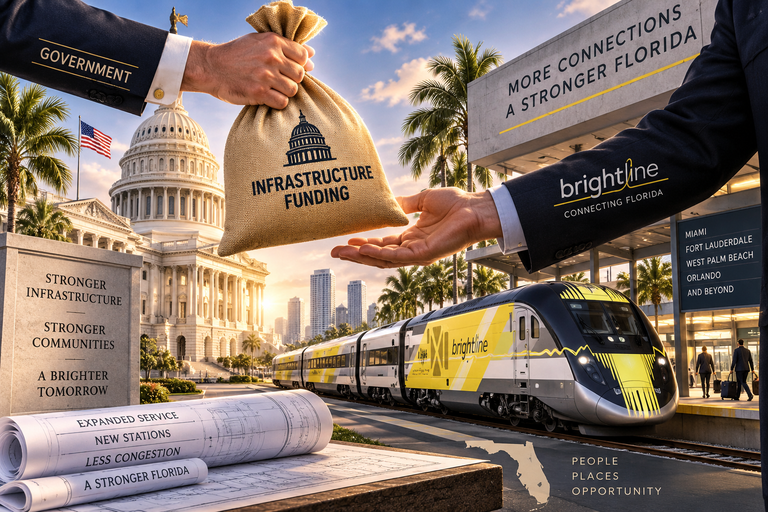
Brightline will now be looking to government for help financing the next stage of the system. If Florida and Washington believe passenger rail provides a genuine public benefit—reducing highway congestion, connecting major cities and airports, and supporting long-term transportation capacity—then it may make little sense to demand that every dollar of infrastructure be carried on the balance sheet of a private operator. Government does not necessarily have to own or operate Brightline, but it could help finance stations, track improvements, bridges, rights-of-way and future expansion while the private company remains responsible for running the trains and attracting passengers. The real question should not be whether the money is labeled “public” or “private,” but whether the investment produces infrastructure Florida will still be using 30, 50 or 100 years from now.