
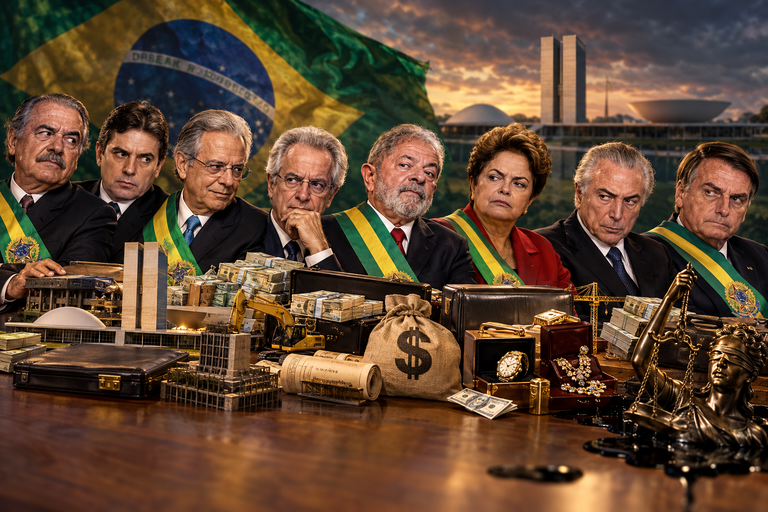
When you have to search through forty years of scandals, missing money, political favors, and presidential excuses to find an honest man, there might be something wrong with the system. — YNOT
Some countries produce great scientists, writers, and inventors. Brazil produces presidents who eventually require lawyers.
Miami readers have a front-row seat. South Florida is home to one of the largest Brazilian communities in America, Brazilian money is a force in our real estate market — just this week we reported on the Bolsonaro family buying land here after fleeing Brazil — and plenty of our Brazilian neighbors will tell you exactly why they left: a country rich in oil, gold, agriculture, and talent, where politics keeps turning public wealth into private fortunes.
So we asked a simple question: who was the last Brazilian president to leave office without a substantial personal corruption scandal attached to his name? Brazil has had only eight presidents since civilian rule returned in 1985. How far back could we possibly have to go?
Quite a distance, as it turns out.
The Roll Call, Going Backward
Start with the present. Lula da Silva returned to the presidency after spending 580 days in prison on corruption convictions from the Operation Car Wash investigations into Petrobras, the state oil giant. His convictions were annulled in 2021 on legal grounds — improper jurisdiction and judicial bias — which erased the verdicts without declaring the evidence imaginary.
Before him, Jair Bolsonaro left office under a storm of investigations and was later convicted over the plot to overturn the election he lost. Michel Temer was recorded, accused of taking bribes, and arrested after leaving office. Dilma Rousseff was impeached in 2016 while the Petrobras scandal consumed the government she led. Go back further and you reach Lula again, then Fernando Henrique Cardoso, whose presidency carried its own vote-buying allegations around a reelection amendment.
Before Cardoso, the trail finally stops: Itamar Franco, president from 1992 to 1994. Franco’s government was not scandal-free — no Brazilian government is — but his personal reputation for honesty was repeatedly noted by the observers of his time, and no comparable personal bribery case ever attached to him. And on the other side of Franco? Fernando Collor, who resigned in 1992 facing impeachment and was convicted decades later in a separate corruption case, and José Sarney, whose cases mostly died of old age in court.
Read that again. To find a Brazilian president remembered mainly for being honest, you have to travel back more than thirty years.
It Is the System, Not Just the Men
One distinction matters, and we will keep making it: accused is not convicted. Some of these men were acquitted, some had convictions overturned, some saw the statute of limitations quietly run out. Brazil’s courts take decades, and half the country ends up unsure what actually happened — a sporting event where the final score is announced twenty years after the players retire.
But the pattern is the story. Coalition bargaining, patronage appointments, opaque campaign money, and giant state companies handing out giant contracts: the machinery produces the scandal no matter who sits in the chair. And corruption has victims who never see a courtroom — the taxpayer funding the contract, the commuter waiting on the unfinished project, the patient in the hospital without equipment, the student in the crumbling school.
Why Miami Should Care
Every wave of Brazilian dysfunction sends another wave of Brazilian families, businesses, and capital to South Florida. They bring money, energy, and talent — and a deep, earned skepticism of government. Miami is better for their arrival. Brazil is poorer for the reasons they left.
Perhaps Brazil’s next great innovation will be a president remembered for what he accomplished rather than what prosecutors investigated. Until then, the title stands: when it comes to the Olympics of corruption, Brazil keeps winning the gold — and would probably find a way to bribe the judges just to make sure.
Adapted from “THE LAST NOT-CORRUPT BRAZILIAN PRESIDENT” at In Search of Your Passions, where the full presidential roll call appears.
