
There is a simple rule in public life: if a company is paying you, you do not walk into a government meeting and ask that government to fund the company — and if you do, you say the company is paying you, out loud, before you make the pitch.
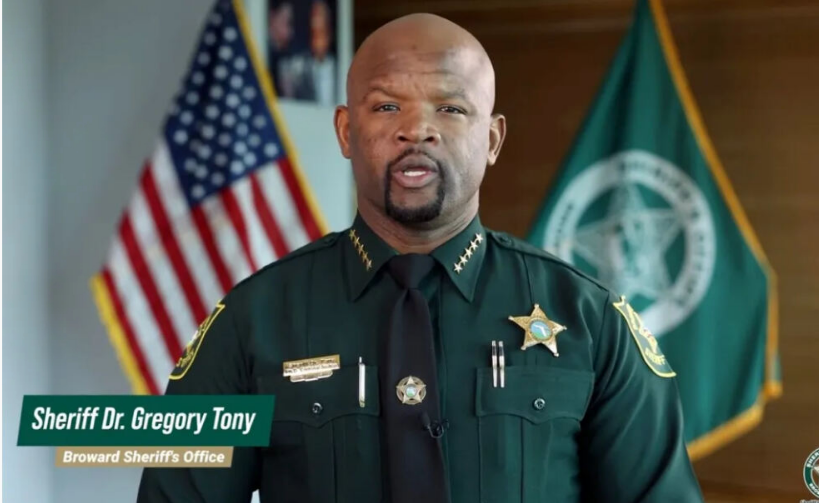
Broward Sheriff Gregory Tony appears to have done the opposite. According to a Florida Bulldog investigation published November 1, Tony was paid $65,000 last year by the Opioid Training Institute, a for-profit company that sells online opioid-crisis courses to first responders. Then, on March 31, he stood before Florida’s Statewide Council on Opioid Abatement — the body that advises how the state’s opioid settlement billions should be spent — and urged support for a $3 million statewide pilot program built around that same company’s training.
Nowhere in that 40-minute presentation, per the Bulldog’s review of the meeting video and minutes, did the sheriff mention the $65,000.
The Pitch, and What Was Missing From It
The product is a four-hour online course, marketed with the University of Miami, on responding to opioid use disorder crises — de-escalation, crisis intervention, connecting people to treatment. It normally costs $450 per participant. For the proposed $3 million state pilot, the price would drop to $200 a head, with the real prize being what comes after: a successful pilot would put the company first in line for a long-term state contract.
Tony told the council that nearly 26,000 Florida first responders had been unable to take the course because funding was unavailable. That may well be true. Training first responders to handle opioid crises is genuinely important work, and nobody should doubt the need.
But the council was not told that the man making the case had been paid by the vendor. The payment surfaced in Tony’s own financial disclosure filing — paperwork, filed away, that no one in that room was pointed to. Disclosure in a filing cabinet is not disclosure. When you stand up to sell a program, the audience is entitled to hear about your financial interest in it, in the room, on the record.
The Company He Was Selling
Then there is the company itself. The Opioid Training Institute is part of Fort Lauderdale-based Zschool. Its leader, J. Henry Scott, confirmed to the Bulldog that Tony had worked as a consultant — helping formulate programming and serving on the advisory board that oversees it — and that he no longer does.
What Scott did not volunteer, and what the Bulldog dug up, is his own history. Before he was J. Henry Scott, he was Scott Pasch, whose New Jersey telemarketing firm was accused by the Federal Trade Commission of running a charitable-solicitation scheme in the name of police, firefighters and veterans — causes that allegedly saw only a small portion of the money raised. In 2010 the FTC permanently banned him from telemarketing and charitable soliciting; his company was ordered to pay $18.8 million, with $5.8 million of that judgment his. The defendants did not admit the allegations. Months later, he changed his name.
Scott told the Bulldog the name change had nothing to do with the FTC case. Perhaps. But a state council deciding where settlement money goes deserves to weigh all of this — and it cannot weigh what it is never told.
Why This Matters Beyond One Meeting
Florida’s share of the national opioid settlements is roughly $3.5 billion, money extracted from the manufacturers, distributors and pharmacy chains that fueled the crisis. It is supposed to go to treatment, recovery and prevention — naloxone kits, recovery housing, the CORE Network. Every dollar steered toward a vendor’s pilot program is a dollar not spent somewhere else, and the steering has to be clean.
The Bulldog notes that Tony’s appearance appears to violate both Florida’s Constitution, which bars public officers — sheriffs included — from lobbying for compensation on policy and appropriations matters while in office, and the state’s Misuse of Public Position law. No ethics body has ruled on any of this, and Tony has not answered the Bulldog’s questions about what the $65,000 was for. He should answer them — here, and anywhere else he’s asked.
Context makes it worse, not better. This is the same sheriff locked in a bitter feud with Broward County over his $840 million budget, the same sheriff whose agency is being stripped of fire-rescue, 911 dispatch and airport and seaport security by commissioners who say he won’t level with them about the numbers. Trust is the whole argument. A $65,000 undisclosed side payment from a vendor he then promoted to the state does not rebuild it.
What Should Happen Now
The opioid abatement council meets again on November 4. The pilot proposal should not move one inch until three things happen: the sheriff publicly explains the $65,000 — what it paid for and when; the council puts the disclosure failure on its own record; and any training contract, pilot or otherwise, goes through open, competitive bidding against established providers, judged on price and results rather than access.
Opioid settlement money exists because hundreds of thousands of Americans died and a handful of companies settled to make the lawsuits stop. South Florida’s first responders deserve good training. Broward’s taxpayers deserve a sheriff who sells them nothing but his judgment — and discloses it when someone else is paying for his time.
This editorial is based on reporting by Dan Christensen of Florida Bulldog, “Broward Sheriff Tony received $65,000 from opioid training firm, then urged state funding for its program,” published November 1, 2026: https://www.floridabulldog.org/2026/11/sheriff-tony-received-65k-opioid-training-firm-urged-state-funding-for-its-program/
