
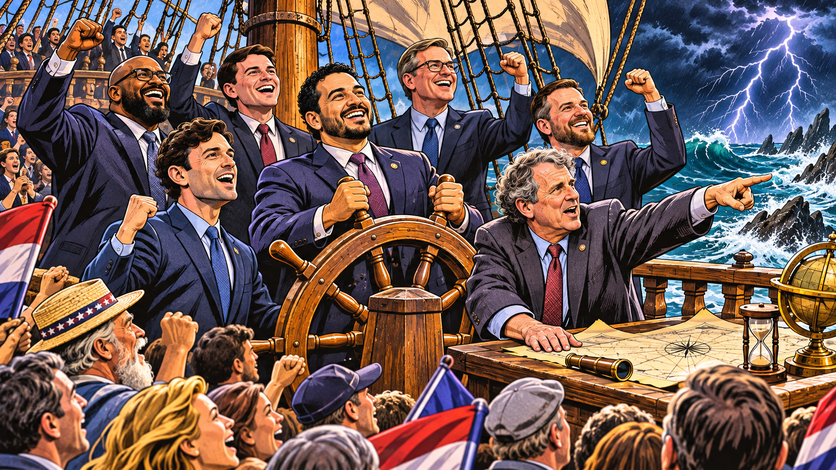
The trouble with democracy is not that fools are allowed to vote. It is that fools, wise men, scoundrels, and geniuses all get one vote apiece — and the fellow who promises the most usually gets to steer.
Miami woke up this morning to a finished election. The Blue Wave took the House and the Senate, Texas turned, Florida stayed red, and up and down the ballot — from Congress to the county — South Florida has a fresh crew of captains this morning. Congratulations to the winners. Now comes the only question that ever really mattered: can any of them sail?
The Ship Everybody Owns, But Nobody Knows How to Sail
Imagine a magnificent ship. Powerful engines, enormous sails, provisions for thousands, and a crew drawn from every walk of life. Every passenger owns an equal share of the vessel, and every few years they gather to elect a captain.
One candidate steps forward with thirty years of experience. He knows navigation, understands the weather, and warns the passengers honestly: there are reefs ahead, the engines need maintenance, supplies must be conserved, and reaching the destination will require sacrifice.
His opponent steps forward. He has never captained anything. He couldn’t tell a compass from a dinner plate. But he has magnificent hair, a beautiful smile, and a voice that could persuade a fish to purchase swimming lessons. He promises sunshine every day, free meals for everyone, no taxes on the voyage, a shorter journey — and he personally guarantees the ocean will cooperate.
The passengers erupt in applause. The navigator tries to explain that no captain controls the weather. The crowd boos. The other fellow announces the navigator is spreading fear and negativity. Someone starts chanting. Someone else sells hats.
When the votes are counted, the fellow who knows nothing about sailing wins by a comfortable margin. Welcome aboard the Ship of Fools. Destination: wherever the wind takes us.
If that sounds like any campaign season you have ever lived through in Miami-Dade, there is a reason. A Greek noticed it first.
Plato Saw This Coming 2,400 Years Ago
In The Republic, Plato described a ship whose sailors fight over the captaincy while ignoring the one person who actually understands navigation. The sailors know how to compete for control — how to flatter the shipowner, organize factions, and seize the helm. What they don’t know is how to sail. The true navigator studies the stars, the seasons, and the winds, and for his trouble the sailors regard him as useless. After all, what good is a man who knows how to steer when he doesn’t know how to win an election?
Plato watched Athens — a city that celebrated public participation — get swayed by persuasive orators into the catastrophic Sicily expedition, one of the worst military disasters of the ancient world. His lesson has not expired: a majority vote does not magically transform a foolish decision into a wise one. The ocean does not care how many people voted to ignore the storm. Neither does reality.
Ask anyone in South Florida who has lived through hurricane season. The storm does not check the election results before it makes landfall.
Charisma Wins Elections. It Does Not Govern
Here is the uncomfortable contradiction at the heart of our system. A physician must study medicine. A pilot must learn to fly. An engineer must understand why bridges stand. Even your barber needs a license. But the person seeking enormous political power is judged mainly on whether people like the sound of his voice.
Eligibility is not competence. Winning elections and governing are two fundamentally different occupations. Campaigning rewards confidence; governing requires judgment. Campaigning rewards simple answers and impossible promises; governing requires understanding complicated problems and delivering results. Campaigning rewards telling voters what they want to hear. Governing sometimes requires telling them exactly what they don’t want to hear.
Science rubs salt in the wound. In a well-known Princeton study, people judging candidates’ faces from photographs — knowing nothing of their policies, records, or even names — picked the actual winner in roughly seven out of ten races. A face was enough. We tell ourselves we vote on the issues. Too often, we vote on the jawline.
Florida just ran this experiment again at full scale. Some of yesterday’s winners are navigators. Some are hat-sellers with great hair. This morning, both kinds hold the same helm.
The Real Problem Is Not the Captain — It Is the Passengers
Plato’s own cure — let the wise men rule and stop asking the passengers — is nearly as troublesome as the disease, and America was right to reject it. Churchill had the honest verdict: democracy is the worst form of government, except for all the others that have been tried.
Because here is the part of the parable we skip: the passengers choose. Every reef this ship hits was voted for by somebody. The captain who promised calm seas got there because the passengers preferred the promise to the warning. The most dangerous passenger on the ship is not the fool — it is the citizen who refuses to think, who votes the way he has always voted, for the name he recognizes, the face he likes, the promise that costs him nothing.
Miami and Florida made their choices yesterday, in an election with real stakes — amendments passed and failed, sheriffs and judges and commissioners chosen, a state that held its color while the country changed its mind. The voting is the easy part. The sailing starts now.
So hold the new crew to a navigator’s standard. When the weather turns — and in South Florida, the weather always turns — watch whether your captain reaches for the charts or reaches for a microphone. One of those men can sail. The other one just knows how to win the vote for captain.
Democracy is a marvelous invention. It allows every man a voice in choosing the captain, including those who cannot swim, cannot read a compass, and believe the ocean is a conspiracy. The tragedy is not that they may choose poorly. It is that, after voting to sail directly into a hurricane, they will spend the rest of the voyage blaming the weather.
Welcome aboard, Miami. Life jackets are available — but only after a committee determines whether their distribution would be politically fair.
Adapted from “Ship of Fools Theory — How Democracy Works” by YNOT, published on In Search of Your Passions: read the original essay.
