
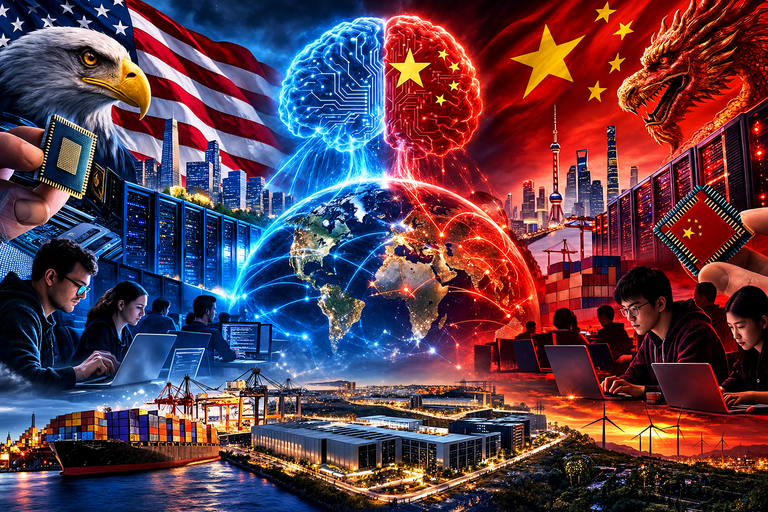
A war is underway that will shape Miami’s economy for the next generation, and it is not being fought with ships or soldiers. It is being fought with computer chips, data centers, and electricity — a global battle between the United States and China for control of artificial intelligence. Miami, which has spent years selling itself as the next great American tech hub and the gateway to Latin America, sits closer to the front lines than most people here realize.
The stakes are simple to state. America builds the world’s most advanced AI and rents it out by the month. China is building AI that is nearly as good and giving much of it away. Which of those two models the world chooses will decide what Miami’s businesses pay for intelligence, where the data centers get built, whose technology Latin America runs on, and which local jobs disappear — or appear.
Rent the Brain, or Own the Machine
America’s leading AI companies — OpenAI, Anthropic, and Google’s most advanced systems — operate like landlords. They spend billions building extraordinarily capable machines, then charge everyone rent: subscriptions, per-use fees, enterprise contracts. The intelligence lives on their servers, under their rules, and the meter never stops running.
China’s developers have made the opposite bet. Alibaba’s Qwen, DeepSeek, Moonshot AI, and others release open-weight models that any organization can download and run on its own equipment. In July 2026, Moonshot’s Kimi K3 — a 2.8-trillion-parameter open model — demonstrated how close Chinese systems have come to the American frontier.
For a Miami business, this is not an abstract debate. A Brickell law firm, a Doral logistics company, or a Wynwood startup that rents its AI from California pays California prices, forever, in a cost structure it does not control. The same business running an open model on its own servers owns its tools the way it owns its trucks and its office equipment. Multiply that decision by every company in South Florida and you get a real economic fork in the road.
Miami’s Bridge to Latin America Is in Play
Miami’s special role in the hemisphere is exactly what makes this city a prize in the AI war. South Florida is the business capital of Latin America — its banks, law firms, airlines, and trading companies serve markets from Mexico City to Buenos Aires. Those markets are now choosing their AI foundations, and price matters there even more than it does here.
A government ministry, university, or hospital system in Latin America comparing an excellent American system with permanent dollar-denominated subscription fees against a capable Chinese open model its own engineers can run locally will often choose independence and price. Once a region’s developers and institutions build on one technology, that choice hardens into a standard — and standards are what this war is really about.
If Latin America builds on Chinese AI, the technology flowing through Miami’s banks, ports, and professional firms will increasingly be Chinese underneath, whatever flag flies on the building. If it builds on American AI, Miami’s role as the hemisphere’s American bridge gets stronger. Either way, this city has more riding on the outcome than almost any other in the United States.
Data Centers, Electricity, and Florida Heat
AI runs on physical things: chips, servers, cooling, and above all electricity. The International Energy Agency estimates the largest data-center operators will spend more than $700 billion on capital spending in 2026, and projects data-center electricity use worldwide could more than double by 2030. Every one of those facilities needs power contracts, water or advanced cooling, hurricane-resistant construction, and land — all of which Florida has in complicated supply.
South Florida already knows what a power-hungry industry looks like. Data centers bring construction jobs, permanent technical jobs, and serious tax base, but they also compete with residents for electricity and strain a grid that must survive hurricane season. The communities that plan for power generation and transmission now will host the AI economy. The ones that only issue press releases will watch it land in Texas, Virginia, and Georgia instead — or in Chinese-built facilities across Latin America and the Caribbean, in Miami’s own backyard.
The Huang Shock Reaches South Florida
The war took a startling turn this week. On November 12, Nvidia — the company whose chips power nearly the entire AI industry — announced that its co-founder and CEO, Jensen Huang, had resigned, with Colette Kress named interim CEO. The departure followed reports of Huang’s personal relationships, including an affair with a businesswoman American intelligence officials reportedly suspected of passing information to Beijing. Nvidia says it has no reason to believe its secrets or national security were compromised, and the allegations remain allegations.
Huang mattered beyond one company. He was the loudest corporate voice arguing that open AI is essential to American leadership — that if America restricts open technology while China distributes it freely, America surrenders the world’s developers. His fall, in a scandal touching China itself, lands at the exact moment that argument is being decided in Washington. What Washington chooses will set the prices, the rules, and the competitive field for every AI-dependent business in Miami.
What It Means for Miami Workers
The deepest effects will land on ordinary people. The International Monetary Fund estimates roughly 40 percent of jobs worldwide are exposed to AI-driven change, with even greater exposure in advanced economies — and South Florida’s economy runs on exactly the kind of work AI reaches first: banking and finance, real estate, law, tourism services, health care administration, logistics, and customer service.
Exposure does not mean every job vanishes. It means the same office may soon do the same work with fewer people, while new work appears for those who learn to run the machines. A Miami that trains its workforce — through its universities, colleges, and employers — can come out of this transition richer. A Miami that treats AI as somebody else’s problem will find the gains flowing to shareholders somewhere else while the disruption stays local.
The Verdict for the Magic City
World War AI will probably not produce a single winner. America is likely to keep its edge in the most advanced chips and research; China is likely to keep spreading capable, inexpensive AI across the developing world; and intelligence itself looks set to become a utility — enormously valuable, widely available, and much harder to rent at luxury prices than today’s valuations assume.
For Miami, the lesson is the same one this city has learned in every economic era: the winners are the ones who build the port, not the ones who argue about the ships. Affordable AI — American, Chinese, or both — is a tool Miami’s entrepreneurs, universities, and Latin America-facing businesses can build on right now. The cities and countries that adapt fastest will take the prize. Miami has the location, the hemisphere’s trust, and the entrepreneurial energy. What it cannot afford is to sit out the defining technology fight of the century and hope the outcome arrives by itself.
Adapted from “World War AI” by YNOT at In Search of Your Passions.
