
Dear Governor DeSantis and Governor-Elect Donalds,
I am writing to bring attention to a growing public safety problem on Florida’s streets, particularly here in South Florida. It is a problem that did not exist in its present form just a few years ago, and one that our laws have not adequately addressed.
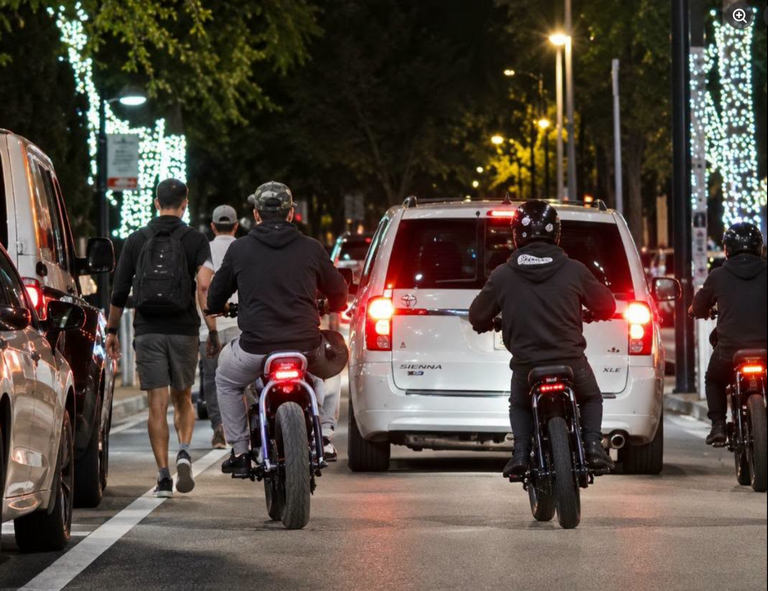
I am referring to the proliferation of increasingly powerful electric bicycles and electric motorcycles, many operating without license plates, registration, or any readily visible means of identifying their operators.
There is a new problem developing on the streets of South Florida. It is something that barely existed a decade ago, and our laws and enforcement practices have struggled to keep up with the technology. I am talking about electric bicycles. Not the ordinary electric bicycle that helps someone pedal to work, visit the grocery store, or enjoy an afternoon ride along the beach.
I am talking about the increasingly powerful electric machines that resemble motorcycles, accelerate quickly, and can travel at speeds that would have been unimaginable for an ordinary bicycle just a few years ago. Some are legitimate electric bicycles. Others are essentially electric motorcycles being operated without the identification and legal requirements associated with motorcycles. And when a group of individuals decides to use these machines to threaten people, intimidate motorists, or cause property damage, we have a problem that goes far beyond traffic safety. We have an accountability problem.
AN INCIDENT IN FORT LAUDERDALE
On a recent evening, a woman reported witnessing a disturbing confrontation at Oakland Park Boulevard and A1A in Fort Lauderdale. According to her published eyewitness account, approximately eight or nine teenage boys dressed in dark clothing were riding small electric mopeds or moped-style e-bikes. The group allegedly surrounded and harassed a motorist in a light-colored vehicle. She described riders striking the vehicle, shouting obscenities, making threats, and deliberately damaging the driver’s side-view mirror.
Even after the motorist attempted to leave, she reported that the group continued following and threatening him. The woman’s account described the encounter as so aggressive that she reached for the pepper spray she kept in her vehicle, fearing she might become another target. She photographed the riders and offered to cooperate with police. Other residents responding to her post described similar encounters in the Fort Lauderdale and Lauderdale-by-the-Sea area.
Nevertheless, the allegations raise a serious question.
What happens when groups of aggressive individuals have access to fast, highly maneuverable vehicles that display no license plates and can move between streets, bicycle lanes, and pedestrian areas?
And what happens when identifying the operators becomes considerably more difficult than identifying someone driving an automobile?
THE TECHNOLOGY HAS CHANGED EVERYTHING
Think about the bicycle most of us grew up riding. It had pedals, a chain, and two wheels. If you wanted to go fast, you had to pedal hard. If you wanted to escape from someone, you had better be in good physical condition. Police officers could often pursue a bicycle rider on foot over short distances, or patrol vehicles could follow where road conditions permitted.
Now consider today’s electric machines. Some electric bicycles operate at 20 to 28 miles per hour with motor assistance. More powerful electric machines can exceed those speeds, depending on their design and specifications. They accelerate quickly, maneuver through traffic, and may be physically small enough to navigate narrow passageways. A rider can potentially move from a public roadway to a bicycle path or another accessible area in seconds. Unlike a conventional motorcycle, some of these machines are nearly silent. Unlike an automobile, many display no registration plate. And unlike an ordinary bicycle, the motor supplies the power. The technology has fundamentally changed what these machines are capable of doing.
But our public policies have not fully adjusted to the consequences.
WHAT DOES FLORIDA LAW ACTUALLY SAY?
Here is where things become interesting. Under Florida Statutes 316.003 and 316.20655, an electric bicycle must have fully operable pedals, a motor rated at less than 750 watts, and fall within one of three legal classifications. Class 1 provides pedal assistance up to 20 miles per hour. Class 2 permits motor propulsion without pedaling, with assistance ending at 20 miles per hour. Class 3 provides pedal assistance up to 28 miles per hour.
These qualifying electric bicycles generally do not require:
- A driver’s license.
- Vehicle registration.
- A license plate.
- A certificate of title.
- Motor-vehicle insurance.
Their operators generally receive the same rights and responsibilities as ordinary bicycle riders. Helmets are required for riders under 16, and municipalities may impose additional lawful restrictions. Now consider another machine. Suppose it looks like a bicycle but has no functional pedals and a considerably more powerful motor. Or suppose it can travel 40 or 50 miles per hour under electric power. That machine does not automatically qualify as an electric bicycle under Florida law.
Depending on its specifications, it may be classified as a motorcycle or another regulated motorized vehicle. Some off-road electric motorcycles cannot legally be operated on public streets at all. Those distinctions matter.
Simply calling something an e-bike does not make it one under the law.
Unfortunately, the average motorist cannot determine a machine’s wattage, legal classification, or maximum assisted speed by looking at it as it passes. Neither can someone watching a surveillance video. The vehicles pictured in the Fort Lauderdale social media account cannot be reliably classified from the photographs alone.
That is part of the difficulty.
THE IDENTIFICATION PROBLEM
Now we arrive at what I believe is the most overlooked issue. Consider what happens when someone driving an automobile commits a traffic offense or deliberately damages another vehicle.
There is generally a license plate. That plate can help investigators identify the registered owner. The owner is not necessarily the driver, but the registration provides investigators with a starting point. A motorcycle has similar identification requirements. A qualifying electric bicycle does not. There may be a manufacturer label or a serial number on the frame, but that is of limited use to someone watching the vehicle disappear down the street. Now imagine eight or nine riders operating together. They are dressed similarly. Some wear helmets that obscure identifying facial features. Their machines have no visible registration plates. They may be able to separate into different streets or neighborhoods in a matter of seconds.
How does a witness identify the individuals involved?
How does a police officer connect a particular machine to its owner?
How does an investigator determine whether the same riders have been involved in previous incidents?
It is not impossible. Police can use photographs, surveillance recordings, witness statements, serial numbers, and other evidence.
But the absence of visible identification removes one potentially valuable investigative tool.
We have created a category of motorized transportation that can travel considerable distances on public infrastructure without the same visible identification required of automobiles and motorcycles.
That deserves a serious policy discussion.
WHEN DOES A GROUP OF RIDERS BECOME A PUBLIC SAFETY THREAT?
There is another distinction we should make. A group of teenagers riding bicycles together is not automatically a gang. Teenagers gathering with friends is nothing new. And irresponsible behavior is not unique to young people. But when individuals surround a motorist, threaten someone, deliberately damage property, and pursue a frightened driver, the issue is no longer whether the activity is an innocent recreational outing. It is potentially criminal conduct. Florida already has laws addressing assault and intentional property damage. Under Florida Statute 806.13, deliberately damaging another person’s property can constitute criminal mischief. Under Florida Statute 784.011, certain threats of imminent violence can constitute assault. We do not need a new law declaring that smashing someone’s mirror is illegal. That law already exists. The real questions are whether offenders can be identified, whether police have sufficient resources to respond, and whether existing laws can be enforced effectively. And that leads to an uncomfortable reality. If a group of riders knows that police cannot safely pursue them through congested streets or pedestrian areas, they may believe they can act without consequences. That perception alone can encourage increasingly reckless behavior. It is a dangerous situation for everyone, including the riders themselves.
FORT LAUDERDALE IS ALREADY DISCUSSING THE PROBLEM
This is not merely a hypothetical concern. Fort Lauderdale officials have been debating additional regulations governing e-bikes and other micromobility devices. At a November 17, 2026, City Commission conference meeting, officials discussed a proposed ordinance dealing with their use in parks and other public areas. Proposals have included restrictions on riding through park pathways, minimum operator ages, and additional sidewalk regulations. City officials have also discussed the practical difficulty of enforcing restrictions with limited police resources. The broader regulations remain under development. That is important because the technology is advancing faster than many local governments can establish consistent rules.
Consider that a rider traveling through Fort Lauderdale may cross into Lauderdale-by-the-Sea and eventually Pompano Beach. Different municipalities may impose different local restrictions. An ordinance governing a city park does not necessarily solve a public safety problem occurring along A1A. We need regional coordination, not simply another patchwork of rules that changes every few miles.
FLORIDA TRIED TO ADDRESS E-BIKE SAFETY IN 2026
Earlier this year, Florida lawmakers approved Senate Bill 382, legislation addressing micromobility safety. The proposal would have established additional rules for electric bicycles operating near pedestrians. Among other provisions, it would have limited e-bikes to 10 miles per hour when operating on sidewalks or other pedestrian areas within 50 feet of a pedestrian. It also proposed a statewide micromobility safety task force and additional crash-data collection. The legislation passed both chambers unanimously.
The Florida Senate voted 37–0.
The Florida House voted 112–0.
But Governor Ron DeSantis vetoed the legislation on June 25, 2026. His objections included concerns that the proposed speed standard would be difficult for riders to judge, could encourage expanded government surveillance, and would create an open-ended regulatory task force. Those are legitimate concerns to consider. We should not surrender everyone’s privacy because some individuals behave irresponsibly. But neither should privacy concerns prevent reasonable identification requirements for machines that operate more like motorcycles than bicycles.
The answer must balance freedom, personal responsibility, and public safety.
MY PROPOSAL: UPDATE THE RULES WITHOUT PUNISHING EVERYONE
I do not believe we should ban electric bicycles. I have one. They provide affordable transportation, reduce fuel consumption, and offer mobility to people who may not want or need an automobile. They are especially useful in South Florida, where distances can make ordinary cycling difficult. But we need to recognize that not every electrically powered two-wheeled machine belongs in the same regulatory category.
Here is what I believe Florida should do.
1. Clearly distinguish electric bicycles from electric motorcycles.
Florida already has technical definitions. Those definitions need to be consistently applied. A high-powered electric motorcycle should not receive bicycle exemptions simply because its manufacturer or owner calls it an e-bike.
2. Enforce existing motorcycle registration requirements.
When a machine legally qualifies as a motorcycle and is operated on public roads, applicable registration, licensing, and equipment laws should be enforced. The same principle applies to other regulated motorized vehicles.
3. Consider visible identification for higher-performance electric bicycles.
Florida should study whether certain higher-performance machines that currently qualify as e-bikes warrant a proportionate identification system. This would require careful legislation, clear classification standards, privacy protections, and consideration of costs. It should not become an excuse to burden every person who rides a conventional bicycle.
4. Establish practical age and safety regulations.
Florida already permits local governments to establish minimum e-bike operator ages and require riders to carry government-issued photographic identification. Cities should evaluate those tools rather than assume they have no regulatory authority. Education, parental involvement, and appropriate equipment standards should accompany enforcement.
5. Improve coordination between neighboring police departments.
Riders do not necessarily stop at municipal boundaries. Fort Lauderdale, Lauderdale-by-the-Sea, Pompano Beach, and surrounding jurisdictions should have coordinated procedures for reporting dangerous incidents and sharing relevant evidence.
6. Make dangerous group behavior an enforcement priority.
Traffic enforcement should distinguish between responsible recreational riders and individuals deliberately intimidating motorists or pedestrians. Where the evidence supports criminal charges, offenders should be held accountable. For juveniles, that should include appropriate parental involvement, restitution, and corrective intervention. The objective is not simply punishment. It is preventing the next incident from becoming a serious injury or fatal confrontation.
THE PARENTS NEED TO PAY ATTENTION
There is another group that needs to be part of this conversation. Parents.
If your teenager owns an electric bicycle or electric motorcycle, do you know how powerful it is?
Do you know its maximum speed?
Do you know whether it is legally permitted on public roads?
Do you know where your child is riding at night?
And most importantly, do you know who your child is riding with?
A machine capable of carrying a teenager through busy intersections at motorcycle-like speeds is not simply another toy.
It is a responsibility.
And when that machine is used to threaten someone or damage property, the consequences can extend far beyond a traffic ticket.
THE BIGGER PROBLEM: TECHNOLOGY IS MOVING FASTER THAN GOVERNMENT
We have seen this before. Technology changes the world, and government spends years trying to determine how existing laws apply. Electric scooters, drones, autonomous vehicles, artificial intelligence, and now powerful electric bicycles all illustrate the same problem. The technology does not wait for lawmakers.
Consider the transformation. A conventional bicycle was limited largely by human muscle. A modern electric bicycle can travel 20 to 28 miles per hour with assistance.
An electric motorcycle can go considerably faster. Yet to an inexperienced observer, all three may look like some variation of a bicycle.
The legal distinction is hidden in the motor, the engineering, and the machine’s capabilities. That creates confusion for consumers, parents, police officers, and the public.
And whenever laws become confusing or difficult to enforce, irresponsible individuals can take advantage of the uncertainty.
FINAL THOUGHTS
The most disturbing part of the Fort Lauderdale witness account is not that teenagers were riding electric bicycles. It is the allegation that a group deliberately threatened a motorist, damaged his vehicle, and continued pursuing him. Imagine being that driver. You are stopped at a traffic light. A group of riders surrounds your car. They begin striking it and threatening you. You get out to inspect the damage, and they return. Your mirror is smashed. You attempt to leave, and they follow. What are you supposed to do?
If you confront them, the situation could turn violent.
If you attempt to escape, you risk causing an accident.
If you call police, there is no guarantee officers will arrive before the riders disappear.
That is not an acceptable situation on a public street.
Electric bicycles are an extraordinary technological advancement.
But technological progress does not eliminate personal responsibility.
And freedom to operate a vehicle should never mean freedom from accountability.
Florida does not need to outlaw electric bicycles.
It needs to enforce the laws already on the books, distinguish bicycles from electric motorcycles, consider sensible identification requirements, and give police practical tools to deal with dangerous behavior. Because if we wait until someone is seriously injured or killed before addressing the problem, we will have waited too long.
A bicycle should provide freedom of movement. It should not provide freedom from accountability.
And when an electric bicycle becomes a motorcycle in everything but its name, perhaps it is time we start treating it like one.
— Miami Metropolis
Below is an open letter addressed to Governor Ron DeSantis and incoming Governor Byron Donalds concerning Florida’s growing e-bike problem and the need to update our laws to keep pace with technology. I encourage Florida residents who share these concerns to make their voices heard. Feel free to copy this letter, use it as written, or modify it to reflect your own experiences and opinions. Our elected officials need to hear from the people who live, drive, and walk on our streets every day. The more residents who speak up, the more likely this issue is to receive the attention it deserves.
You don’t have to wait for someone else to demand change. Sometimes all it takes is a letter.
AN OPEN LETTER TO GOVERNOR RON DeSANTIS AND
GOVERNOR-ELECT BYRON DONALDS
Subject: Florida’s Growing E-Bike Problem — Technology Has Outpaced Our Laws
Dear Governor DeSantis and Governor-Elect Donalds,
I am writing to bring attention to a growing public safety problem on Florida’s streets, particularly here in South Florida. It is a problem that did not exist in its present form just a few years ago, and one that our laws have not adequately addressed.
I am referring to the proliferation of increasingly powerful electric bicycles and electric motorcycles, many operating without license plates, registration, or any readily visible means of identifying their operators.
Recently, a Fort Lauderdale resident reported witnessing a group of eight or nine teenagers on electric two-wheeled vehicles allegedly surround, threaten, and attack a motorist near Oakland Park Boulevard and A1A. According to her account, they struck his vehicle, deliberately damaged his mirror, and continued pursuing him.
The allegations are disturbing, but they expose a much larger problem.
We have created a situation in which a person can operate a fast, motorized vehicle on our public streets without a license plate, without registration, and, in many cases, without a driver’s license.
To be clear, Florida already requires registration and licensing for vehicles legally classified as motorcycles. But qualifying electric bicycles enjoy broad exemptions, and the physical appearance of these machines does not always reveal which laws apply.
A conventional bicycle was never a particularly effective getaway vehicle. Today’s electric machines can accelerate rapidly, cover considerable distances, and navigate streets, bicycle paths, and other accessible areas.
And when their operators deliberately threaten motorists or damage property, the absence of visible identification can make investigating those offenses considerably more difficult.
Governor DeSantis, I recognize that you vetoed Senate Bill 382 in June 2026, despite its unanimous passage through both chambers of the Legislature. I also recognize the concerns surrounding government overreach, surveillance, and unnecessary regulation.
Those concerns deserve consideration.
But there is an important difference between protecting personal freedom and creating an environment in which irresponsible individuals believe they cannot be held accountable.
Governor-elect Donalds, as you prepare to take office, I encourage you to make this issue part of your administration’s public safety agenda.
I am not advocating banning electric bicycles or requiring every recreational cyclist to obtain a license.
I am advocating a serious review of how we classify, identify, and regulate increasingly powerful electric two-wheeled vehicles.
We need reasonable identification standards, consistent enforcement of existing motorcycle laws, better coordination between municipalities, and meaningful consequences for people who use these machines to intimidate or endanger others.
Most importantly, we need to act before a confrontation between an aggressive group of riders and a frightened motorist ends in tragedy.
We should not have to wait for someone to die before recognizing that our laws need to catch up with technology.
I respectfully ask both of you, and the Florida Legislature, to examine this problem and develop practical solutions that protect individual freedom while restoring accountability on our streets.
The following Miami Metropolis editorial examines the problem, the existing Florida laws, and several solutions worth considering.
Respectfully,
Miami Metropolis
Independent Commentary on Florida, America, and the Issues That Matter
