
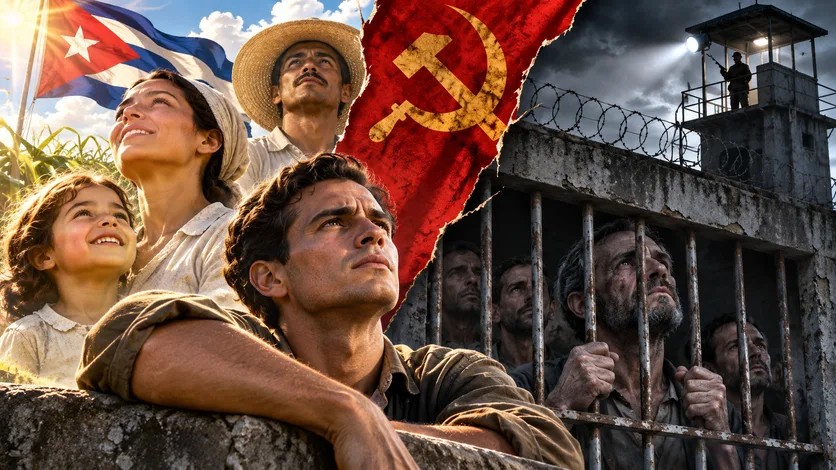
In most American cities, the argument about socialism happens on television. In Miami, it happens at the dinner table. This city is full of people who do not need a history book to know how the story ends, because the story happened to them — to their parents, their grandparents, their neighbors in Little Havana and Hialeah who crossed ninety miles of water to get away from it. So when a new generation starts falling for the old promises again, Miami has a simple answer, and it is the answer this newspaper has given before: don’t listen to the promises. Read what happened.
Castro Promised Elections. Cubans Are Still Waiting.
Fidel Castro did not march into Havana in 1959 announcing a communist state. He promised the opposite. Batista was a dictator, and the broad coalition that backed the revolution — students, workers, businessmen, democratic reformers — believed it was fighting to restore Cuba’s constitution and hold free elections. Castro said so himself, on American television: interviewed on Meet the Press in April 1959, he rejected the idea that his government was communist and promised general elections within four years, preferably sooner. It is all in the contemporary record. The promises were reported as he made them.
Then came the turn. In a March 1959 speech, a voice from the crowd shouted the question that became the revolution’s epitaph: “¿Elecciones para qué?” — elections, for what? By April 1960 Castro was arguing publicly that elections were unnecessary. On May Day 1961 he declared Cuba socialist, and that December he said the quiet part into a microphone: “I am a Marxist-Leninist, and I shall be a Marxist-Leninist to the end of my life.” Independent newspapers such as Diario de la Marina and Prensa Libre were dismantled. Businesses were nationalized. The government took control of the economy and of every institution that might have challenged it. A crowd cheering a leader, it turns out, is not the same thing as a people able to replace him.
The Men Who Believed Him Paid for It
If you want to know what the revolution did to Cubans who disagreed, start with the ones who had fought for it. Huber Matos was a schoolteacher and farmer who became one of Castro’s commanders in the Sierra. In October 1959, alarmed at the communist direction of the new government, he tried to resign his post. He was arrested, tried for treason, and sentenced to twenty years — every one of which he served, from 1959 to 1979. Amnesty International later named him a prisoner of conscience. Armando Valladares, arrested in 1960 as a young man, spent some twenty-two years in Castro’s prisons and lived to write Against All Hope, one of the essential testimonies of the century. Miami does not have to imagine these men. Their families live here.
The Same Script Ran in Moscow and Beijing
Cuba was not an aberration; it was an installment. In 1917 Lenin’s Bolsheviks promised an exhausted Russia “Peace, Land, and Bread” — then lost the election to the Constituent Assembly and simply dissolved it when it convened in January 1918. War Communism followed: nationalized industry, grain seized from peasants at gunpoint. Under Stalin, forced collectivization produced the Holodomor, the 1932–33 famine that killed millions in Ukraine. In China, Mao invited criticism in the Hundred Flowers Campaign of 1956–57, then launched the Anti-Rightist Campaign that labeled roughly 550,000 people for punishment — many of them guilty of nothing more than accepting the invitation to speak. His Great Leap Forward then starved somewhere between 15 and 45 million people, in part because officials who reported failure were destroyed, so officials reported success instead.
Different countries, different decades, one pattern. The leaders claim to speak for the people, so opponents become enemies of the people. Independent institutions — press, courts, unions, businesses — are absorbed or crushed. Economic life is centralized until the state controls the job, the food, and the newspaper. And at the end of the process, the government sits as the sole judge of its own performance, and nobody is left who can tell it that it has failed. Even the fashionable modern version of the argument — that artificial intelligence could finally make central planning work — runs into the same wall. A computer fed fabricated harvest figures by frightened officials will produce beautifully precise nonsense. Technology cannot make an unaccountable government accountable.
The Question Miami Teaches Its Children
None of this means every government program is a road to the Gulag, and the exiles at Miami’s dinner tables are usually the first to make the distinctions: a public health program is not a one-party state, and Denmark is not the Soviet Union. The lesson is narrower and harder. Judge every movement not by the paradise it promises but by the machinery it builds — and ask, before anything else, what would stop its leaders from abusing their power. Can the people vote them out? Can newspapers investigate them? Can courts rule against them? Can a worker organize, a citizen criticize, a family leave? Castro promised elections and delivered a state where the answer to every one of those questions was no. That is the whole warning, and Miami’s families carried it across the water at the cost of everything they owned: the true test of a political system is not what its leaders promise when they want your support. It is what rights you still have when you decide you no longer support them.
This editorial is adapted from “Socialism: Don’t Listen to the Promises. Read What Happened.” by YNOT, originally published at In Search of Your Passions.
